
Built for Shopify's December 1, 2026 Rule: Self-Serve Returns and Exchange Apps Must Move to the Customer Account API

Quick answer: Revize is already Built for Shopify and works with Customer accounts for pre-fulfillment self-service. Shopify's December 1, 2026 rule separately requires returns and exchange apps with buyer-facing self-service to use the Customer Account API for authentication or risk losing that status. 92.2% of post-purchase edits are completed by the customer with no support agent involved (Revize, 2026).
This deadline matters because authentication sits at the entrance to every self-serve return or exchange. A failed migration may not stop the underlying app, but it can put Built for Shopify status and the buyer experience at risk during peak return season.
This guide explains the rule, identifies affected apps, separates returns from pre-fulfillment order editing, and gives agencies a 7-step audit to complete before December 1.

What the Built for Shopify Customer Account API Requirement Changes
On December 1, 2026, returns and exchange apps with buyer-facing self-service must use the Customer Account API as their primary customer-authentication method to retain Built for Shopify status. Shopify announced the change on June 17, 2026, giving affected app developers roughly five and a half months to migrate.
The official Shopify developer changelog also includes subscription apps. For returns teams, the key phrase is buyer-facing self-service: a customer can initiate or manage a return, track an exchange, or take a similar action without staff handling the request.
The consequence is narrower than some deadline summaries suggest. Shopify says non-compliant apps are at risk of losing Built for Shopify status. It does not say every affected app will stop operating, disappear from the App Store, or disable merchant workflows at midnight.
Audit question | Through November 30, 2026 | From December 1, 2026 |
|---|---|---|
Required primary buyer authentication | Existing method may remain | Customer Account API |
Affected categories | Returns, exchanges, subscriptions | Same categories |
Buyer-facing self-service required | Yes, for rule to apply | Yes, for rule to apply |
Immediate stated consequence | Migration window remains open | Built for Shopify status at risk |
Merchant action | Request vendor evidence | Verify production behavior |
Treat December 1 as a vendor-governance deadline, not an automatic storefront shutdown. Agencies should still escalate it now because a status change or rushed authentication release can create avoidable risk during holiday returns.

Who the Built for Shopify Requirement Affects
An app is affected when three conditions overlap: it belongs to the returns, exchanges, or subscriptions category; it provides buyer-facing self-service; and it intends to retain Built for Shopify status after December 1, 2026. A merchant's entire app stack is not automatically in scope.
Use this decision checklist for every post-purchase app:
Check the app category. Confirm how Shopify and the vendor classify the app, rather than inferring its category from a feature name.
Locate buyer-facing workflows. Include return initiation, exchange tracking, subscription updates, and any customer portal that performs those jobs.
Identify the current authentication method. Ask whether Shopify's Customer Account API is already the primary method in production.
Confirm the vendor's Built for Shopify objective. An app without the badge has no badge to lose, although customer-account compatibility may still matter operationally.
Separate pre-fulfillment and post-delivery actions. Changing an unfulfilled order is order editing. Sending a fulfilled product back is a return. Similar customer language does not make them the same workflow.
That last distinction prevents the most common audit mistake. A shopper may call a size correction an "exchange," but replacing a variant before fulfillment avoids reverse logistics entirely. A post-delivery exchange requires a return lifecycle, receipt or inspection logic, and a replacement shipment.
Our dataset shows that across 10 million+ Shopify orders, about 1 in 19 (5.2%) is edited after checkout (Revize, 2026). Agencies should therefore audit both layers, while assigning the December requirement only to the categories Shopify actually named.
What the Customer Account API Actually Does
The Customer Account API authenticates the buyer and gives an app controlled access to that buyer's Shopify account data. An API, or application programming interface, is a governed doorway between systems: the app presents an authorized request, and Shopify returns only the data that request is allowed to access.
This differs from the Admin API, where an app generally acts on behalf of the merchant. Shopify's Customer Account API reference says the customer-facing API reads and updates the buyer's own information, including orders, profiles, and addresses.
As of August 29, 2026, Shopify's reference displays 2026-07 as the latest version. It also documents discovery endpoints, which let an app obtain the correct authentication and GraphQL endpoints for each shop rather than hard-coding one domain.
Authentication is not the same as interface placement. A Customer Account UI extension controls where an experience appears inside customer accounts. The Customer Account API controls authenticated access to customer data. An app can have a polished account-page component and still need its vendor to confirm that the required API is the primary authentication method.
Agencies should request written answers to four technical questions:
Does the production buyer flow authenticate through the Customer Account API?
Which entry points use it, including account pages, order emails, deep links, and external portals?
Is the migration live for every merchant, or only a test cohort?
What evidence will appear in the vendor's Partner Dashboard after the migration is assessed?
Warning: Do not accept "supports new customer accounts" as complete proof. Support for the surface and compliance with the authentication requirement are related, but they are not identical statements.
Where Revize Fits in the December Audit
Revize covers the pre-fulfillment customer self-service layer, while the December 1 rule targets dedicated post-delivery returns and exchange apps. Shopify currently lists the order-editing app as Built for Shopify, compatible with Customer accounts, and categorized under order editing rather than returns and exchanges.
Customers can use its self-serve order-editing portal to change addresses, variants, quantities, or eligible orders before fulfillment. The flow appears on Shopify's order-status surface, and the merchant controls the editing window.
This category boundary is a strength. Correcting the order before it ships prevents an avoidable return from entering the reverse-logistics system. Post-delivery returns remain a separate job, so a high-volume store can pair an order editor with a dedicated returns platform without asking either system to impersonate the other.
Customer need | Operational stage | Correct system | December rule relevance |
|---|---|---|---|
Correct shipping address | Before fulfillment | Order editor | Not targeted by category alone |
Swap size before dispatch | Before fulfillment | Order editor | Not targeted by category alone |
Cancel an eligible order | Before fulfillment | Order editor | Not targeted by category alone |
Send delivered item back | After fulfillment | Returns app | In scope with buyer self-service |
Track replacement shipment | Return or exchange lifecycle | Exchange app | In scope with buyer self-service |
For agencies auditing Plus, Advanced, and Grow stores, the practical move is to preserve that boundary. Keep pre-fulfillment corrections in the order-editing layer, then require separate compliance evidence from the returns vendor. Brands including Square Enix, Venchi, Shelly, Nude Project, AYBL, and TheGameCollection use the customer self-service model across different product categories.
If your stack still sends address, variant, and cancellation requests to support, add the pre-fulfillment self-service layer while the returns vendor completes its December migration.
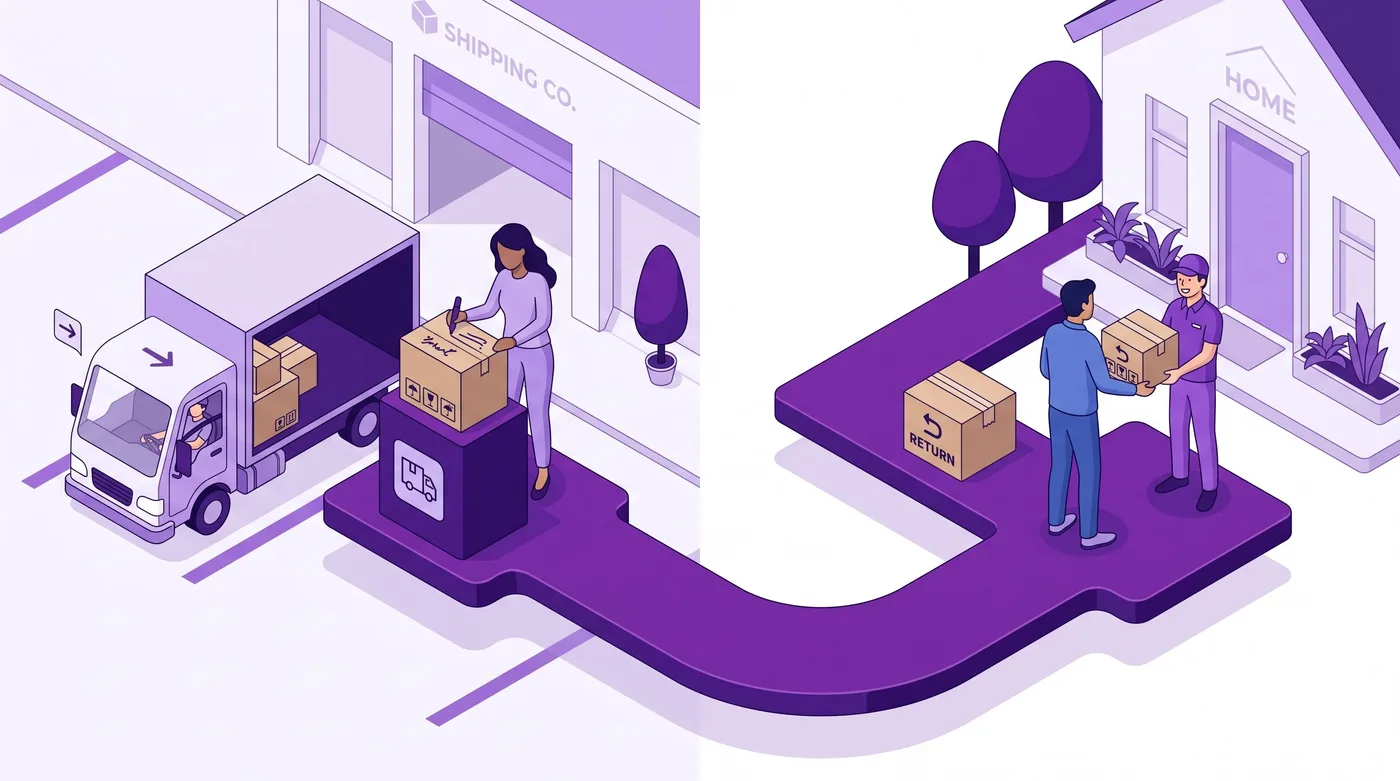
How Agencies Should Audit the Customer Account API Requirement
Run this 7-step audit before December 1, 2026, across every client with self-serve returns, exchanges, or subscriptions. The deliverable should prove production behavior at each buyer entry point, not merely record that a vendor promised a migration.
Build the affected-app inventory. Record each app's Shopify category, Built for Shopify status, customer-facing functions, business owner, technical owner, and renewal date. Separate order editing, tracking, returns, exchanges, subscriptions, help desk, and warehouse functions.
Request a dated vendor statement. Ask whether the app falls within Shopify's announced category requirement and whether the Customer Account API is its primary production authentication method. Require a target release date when the answer is not yet yes.
Map every customer entry point. Test account navigation, order-status pages, confirmation emails, return links, exchange tracking, QR-code destinations, mobile browsers, and headless storefront links. Authentication often looks complete from the main account menu while an older deep link still opens a separate portal.
Inspect the identity transition. Confirm what happens when the buyer is already signed in, signed out, or returning through an older bookmark. Record redirects, repeated login prompts, lost order context, and any path that asks for separate portal credentials.

Run complete return and exchange tests. Use controlled orders to test an eligible return, an ineligible item, a partial return, an exchange, a cancellation, and a customer who abandons then resumes the process. Verify the final state in Shopify and each downstream operations system.
Collect evidence from both sides. Save buyer-flow recordings, Shopify order timelines, vendor release notes, support confirmations, and the date of each test. Ask the app developer to provide its own Built for Shopify assessment evidence where available.
Create a rollback and escalation plan. Document the client owner, agency owner, vendor contact, fallback support process, and decision date for replacing an app that cannot provide credible evidence. Set that decision date before peak-season change freezes.
Do not postpone testing until the badge changes. The most expensive failure is rarely the badge itself. It is a customer being unable to identify their order, resume an exchange, or understand why the familiar account path now behaves differently.
What Actually Breaks After December 1?
Shopify's only explicitly stated December 1 consequence is that a non-compliant affected app risks losing Built for Shopify status. Any stronger claim, including automatic removal from the App Store or immediate shutdown of return portals, goes beyond the published notice.
Merchants should still assess three practical risks:
Trust risk: The app may lose a quality signal merchants use during procurement and stack reviews.
Release risk: A late authentication migration may introduce login loops, broken redirects, or missing order context. Verify these on test orders instead of assuming they will occur.
Support risk: If a self-serve path becomes unreliable, customers may fall back to email or chat during the busiest return period.
The badge is the enforcement mechanism Shopify named. The buyer journey is the business mechanism the merchant must test.
Tip: Put the vendor's claim and your test evidence in the same audit record. A roadmap date proves intent; a completed buyer journey proves readiness.
The Bottom Line for Plus Operators
With 94 days remaining on August 29, agencies should finish discovery in September, production testing in October, and remediation decisions before November change freezes. The December 1 deadline is specific, verifiable, and narrow enough to audit without replacing an entire post-purchase stack.
Here's what to do this week:
Inventory every buyer-facing returns, exchange, and subscription app.
Ask each vendor whether Customer Account API authentication is primary in production.
Test every buyer entry point with controlled orders.
Separate pre-fulfillment editing from post-delivery returns.
Record evidence, owners, deadlines, and a fallback route.
The objective is not migration theater. It is one dependable customer identity across the post-purchase journey, backed by evidence your agency can defend.

Frequently Asked Questions
These answers cover the 10 questions agencies and Plus operators should resolve before December 1, 2026. The published rule is concise, so the safest approach is to distinguish Shopify's exact requirement from operational conclusions that still need vendor evidence and test orders.
What changes on December 1, 2026?
Affected returns, exchange, and subscription apps must use the Customer Account API as their primary customer-authentication method to retain Built for Shopify status. The rule applies when the app provides a buyer-facing self-service experience. Shopify announced the deadline on June 17, 2026.
Will a returns app stop working on December 1?
Shopify has not said affected apps will automatically stop working on December 1. Its published consequence is that apps missing the requirement risk losing Built for Shopify status. Merchants should ask vendors about continuity, then verify the customer journey on test orders instead of predicting an outage.
Does the requirement apply to every Shopify app?
No, the announced requirement does not apply to every Shopify app. Shopify named returns and exchanges apps and subscription apps with buyer-facing self-service. Tracking, help desk, order editing, warehouse, and other categories should not be declared in scope unless Shopify or the vendor provides category-specific evidence.
Is the merchant responsible for the API migration?
The app developer implements the API migration, while the merchant remains responsible for vendor and operational risk. Agencies should obtain the vendor's production status, test affected buyer flows, and document a fallback. A merchant cannot repair a third-party app's authentication architecture through Shopify admin settings.
What is the Customer Account API?
The Customer Account API is Shopify's interface for authenticated buyer access to account data. It lets an app work with information belonging to the signed-in customer, such as orders, profile details, and addresses. Shopify positions it as the common authentication layer across customer accounts, storefronts, and connected apps.
Is the API the same as a Customer Account UI extension?
No, authentication and interface placement are separate concerns. The Customer Account API governs authenticated data access. Customer Account UI extensions place app experiences within Shopify account surfaces, so an app may need both while still proving that the API is its primary authentication method.
Does the entire returns portal need to move?
The published December rule specifically requires the Customer Account API as the primary authentication method. It does not state that every screen must be rebuilt inside one Shopify interface. Agencies should ask vendors which interface and backend components are changing, then test the full flow because authentication affects every downstream step.
How should guest orders be tested?
Test guest orders through the real links and authentication states the vendor supports. Include confirmation-email entry, signed-out browsers, expired sessions, and return visits on another device. Do not assume a successful signed-in account test proves that every guest or pre-authenticated path is ready.
Can a merchant keep its current returns app?
Yes, provided the vendor can demonstrate a credible compliant path and the production workflow passes testing. The deadline does not itself require merchants to replace an app. Replacement becomes an operational decision when the vendor cannot provide evidence, misses agreed milestones, or fails controlled buyer-journey tests.
What should an agency keep as compliance evidence?
Keep the vendor statement, test date, buyer-flow recording, affected order IDs, final Shopify states, and escalation owner. Add screenshots of the app's current Built for Shopify status and relevant Partner Dashboard evidence when the vendor can share it. The record should show observed behavior, not only planned work.
Related Articles
These 3 guides cover the customer-account, checkout, and order-operations changes surrounding the Built for Shopify Customer Account API requirement.
Complete the evidence now, keep each system focused on its proper operational stage, and enter December 1 with a tested customer journey rather than an assumption.
Quick answer: Revize is already Built for Shopify and works with Customer accounts for pre-fulfillment self-service. Shopify's December 1, 2026 rule separately requires returns and exchange apps with buyer-facing self-service to use the Customer Account API for authentication or risk losing that status. 92.2% of post-purchase edits are completed by the customer with no support agent involved (Revize, 2026).
This deadline matters because authentication sits at the entrance to every self-serve return or exchange. A failed migration may not stop the underlying app, but it can put Built for Shopify status and the buyer experience at risk during peak return season.
This guide explains the rule, identifies affected apps, separates returns from pre-fulfillment order editing, and gives agencies a 7-step audit to complete before December 1.

What the Built for Shopify Customer Account API Requirement Changes
On December 1, 2026, returns and exchange apps with buyer-facing self-service must use the Customer Account API as their primary customer-authentication method to retain Built for Shopify status. Shopify announced the change on June 17, 2026, giving affected app developers roughly five and a half months to migrate.
The official Shopify developer changelog also includes subscription apps. For returns teams, the key phrase is buyer-facing self-service: a customer can initiate or manage a return, track an exchange, or take a similar action without staff handling the request.
The consequence is narrower than some deadline summaries suggest. Shopify says non-compliant apps are at risk of losing Built for Shopify status. It does not say every affected app will stop operating, disappear from the App Store, or disable merchant workflows at midnight.
Audit question | Through November 30, 2026 | From December 1, 2026 |
|---|---|---|
Required primary buyer authentication | Existing method may remain | Customer Account API |
Affected categories | Returns, exchanges, subscriptions | Same categories |
Buyer-facing self-service required | Yes, for rule to apply | Yes, for rule to apply |
Immediate stated consequence | Migration window remains open | Built for Shopify status at risk |
Merchant action | Request vendor evidence | Verify production behavior |
Treat December 1 as a vendor-governance deadline, not an automatic storefront shutdown. Agencies should still escalate it now because a status change or rushed authentication release can create avoidable risk during holiday returns.

Who the Built for Shopify Requirement Affects
An app is affected when three conditions overlap: it belongs to the returns, exchanges, or subscriptions category; it provides buyer-facing self-service; and it intends to retain Built for Shopify status after December 1, 2026. A merchant's entire app stack is not automatically in scope.
Use this decision checklist for every post-purchase app:
Check the app category. Confirm how Shopify and the vendor classify the app, rather than inferring its category from a feature name.
Locate buyer-facing workflows. Include return initiation, exchange tracking, subscription updates, and any customer portal that performs those jobs.
Identify the current authentication method. Ask whether Shopify's Customer Account API is already the primary method in production.
Confirm the vendor's Built for Shopify objective. An app without the badge has no badge to lose, although customer-account compatibility may still matter operationally.
Separate pre-fulfillment and post-delivery actions. Changing an unfulfilled order is order editing. Sending a fulfilled product back is a return. Similar customer language does not make them the same workflow.
That last distinction prevents the most common audit mistake. A shopper may call a size correction an "exchange," but replacing a variant before fulfillment avoids reverse logistics entirely. A post-delivery exchange requires a return lifecycle, receipt or inspection logic, and a replacement shipment.
Our dataset shows that across 10 million+ Shopify orders, about 1 in 19 (5.2%) is edited after checkout (Revize, 2026). Agencies should therefore audit both layers, while assigning the December requirement only to the categories Shopify actually named.
What the Customer Account API Actually Does
The Customer Account API authenticates the buyer and gives an app controlled access to that buyer's Shopify account data. An API, or application programming interface, is a governed doorway between systems: the app presents an authorized request, and Shopify returns only the data that request is allowed to access.
This differs from the Admin API, where an app generally acts on behalf of the merchant. Shopify's Customer Account API reference says the customer-facing API reads and updates the buyer's own information, including orders, profiles, and addresses.
As of August 29, 2026, Shopify's reference displays 2026-07 as the latest version. It also documents discovery endpoints, which let an app obtain the correct authentication and GraphQL endpoints for each shop rather than hard-coding one domain.
Authentication is not the same as interface placement. A Customer Account UI extension controls where an experience appears inside customer accounts. The Customer Account API controls authenticated access to customer data. An app can have a polished account-page component and still need its vendor to confirm that the required API is the primary authentication method.
Agencies should request written answers to four technical questions:
Does the production buyer flow authenticate through the Customer Account API?
Which entry points use it, including account pages, order emails, deep links, and external portals?
Is the migration live for every merchant, or only a test cohort?
What evidence will appear in the vendor's Partner Dashboard after the migration is assessed?
Warning: Do not accept "supports new customer accounts" as complete proof. Support for the surface and compliance with the authentication requirement are related, but they are not identical statements.
Where Revize Fits in the December Audit
Revize covers the pre-fulfillment customer self-service layer, while the December 1 rule targets dedicated post-delivery returns and exchange apps. Shopify currently lists the order-editing app as Built for Shopify, compatible with Customer accounts, and categorized under order editing rather than returns and exchanges.
Customers can use its self-serve order-editing portal to change addresses, variants, quantities, or eligible orders before fulfillment. The flow appears on Shopify's order-status surface, and the merchant controls the editing window.
This category boundary is a strength. Correcting the order before it ships prevents an avoidable return from entering the reverse-logistics system. Post-delivery returns remain a separate job, so a high-volume store can pair an order editor with a dedicated returns platform without asking either system to impersonate the other.
Customer need | Operational stage | Correct system | December rule relevance |
|---|---|---|---|
Correct shipping address | Before fulfillment | Order editor | Not targeted by category alone |
Swap size before dispatch | Before fulfillment | Order editor | Not targeted by category alone |
Cancel an eligible order | Before fulfillment | Order editor | Not targeted by category alone |
Send delivered item back | After fulfillment | Returns app | In scope with buyer self-service |
Track replacement shipment | Return or exchange lifecycle | Exchange app | In scope with buyer self-service |
For agencies auditing Plus, Advanced, and Grow stores, the practical move is to preserve that boundary. Keep pre-fulfillment corrections in the order-editing layer, then require separate compliance evidence from the returns vendor. Brands including Square Enix, Venchi, Shelly, Nude Project, AYBL, and TheGameCollection use the customer self-service model across different product categories.
If your stack still sends address, variant, and cancellation requests to support, add the pre-fulfillment self-service layer while the returns vendor completes its December migration.

How Agencies Should Audit the Customer Account API Requirement
Run this 7-step audit before December 1, 2026, across every client with self-serve returns, exchanges, or subscriptions. The deliverable should prove production behavior at each buyer entry point, not merely record that a vendor promised a migration.
Build the affected-app inventory. Record each app's Shopify category, Built for Shopify status, customer-facing functions, business owner, technical owner, and renewal date. Separate order editing, tracking, returns, exchanges, subscriptions, help desk, and warehouse functions.
Request a dated vendor statement. Ask whether the app falls within Shopify's announced category requirement and whether the Customer Account API is its primary production authentication method. Require a target release date when the answer is not yet yes.
Map every customer entry point. Test account navigation, order-status pages, confirmation emails, return links, exchange tracking, QR-code destinations, mobile browsers, and headless storefront links. Authentication often looks complete from the main account menu while an older deep link still opens a separate portal.
Inspect the identity transition. Confirm what happens when the buyer is already signed in, signed out, or returning through an older bookmark. Record redirects, repeated login prompts, lost order context, and any path that asks for separate portal credentials.

Run complete return and exchange tests. Use controlled orders to test an eligible return, an ineligible item, a partial return, an exchange, a cancellation, and a customer who abandons then resumes the process. Verify the final state in Shopify and each downstream operations system.
Collect evidence from both sides. Save buyer-flow recordings, Shopify order timelines, vendor release notes, support confirmations, and the date of each test. Ask the app developer to provide its own Built for Shopify assessment evidence where available.
Create a rollback and escalation plan. Document the client owner, agency owner, vendor contact, fallback support process, and decision date for replacing an app that cannot provide credible evidence. Set that decision date before peak-season change freezes.
Do not postpone testing until the badge changes. The most expensive failure is rarely the badge itself. It is a customer being unable to identify their order, resume an exchange, or understand why the familiar account path now behaves differently.
What Actually Breaks After December 1?
Shopify's only explicitly stated December 1 consequence is that a non-compliant affected app risks losing Built for Shopify status. Any stronger claim, including automatic removal from the App Store or immediate shutdown of return portals, goes beyond the published notice.
Merchants should still assess three practical risks:
Trust risk: The app may lose a quality signal merchants use during procurement and stack reviews.
Release risk: A late authentication migration may introduce login loops, broken redirects, or missing order context. Verify these on test orders instead of assuming they will occur.
Support risk: If a self-serve path becomes unreliable, customers may fall back to email or chat during the busiest return period.
The badge is the enforcement mechanism Shopify named. The buyer journey is the business mechanism the merchant must test.
Tip: Put the vendor's claim and your test evidence in the same audit record. A roadmap date proves intent; a completed buyer journey proves readiness.
The Bottom Line for Plus Operators
With 94 days remaining on August 29, agencies should finish discovery in September, production testing in October, and remediation decisions before November change freezes. The December 1 deadline is specific, verifiable, and narrow enough to audit without replacing an entire post-purchase stack.
Here's what to do this week:
Inventory every buyer-facing returns, exchange, and subscription app.
Ask each vendor whether Customer Account API authentication is primary in production.
Test every buyer entry point with controlled orders.
Separate pre-fulfillment editing from post-delivery returns.
Record evidence, owners, deadlines, and a fallback route.
The objective is not migration theater. It is one dependable customer identity across the post-purchase journey, backed by evidence your agency can defend.

Frequently Asked Questions
These answers cover the 10 questions agencies and Plus operators should resolve before December 1, 2026. The published rule is concise, so the safest approach is to distinguish Shopify's exact requirement from operational conclusions that still need vendor evidence and test orders.
What changes on December 1, 2026?
Affected returns, exchange, and subscription apps must use the Customer Account API as their primary customer-authentication method to retain Built for Shopify status. The rule applies when the app provides a buyer-facing self-service experience. Shopify announced the deadline on June 17, 2026.
Will a returns app stop working on December 1?
Shopify has not said affected apps will automatically stop working on December 1. Its published consequence is that apps missing the requirement risk losing Built for Shopify status. Merchants should ask vendors about continuity, then verify the customer journey on test orders instead of predicting an outage.
Does the requirement apply to every Shopify app?
No, the announced requirement does not apply to every Shopify app. Shopify named returns and exchanges apps and subscription apps with buyer-facing self-service. Tracking, help desk, order editing, warehouse, and other categories should not be declared in scope unless Shopify or the vendor provides category-specific evidence.
Is the merchant responsible for the API migration?
The app developer implements the API migration, while the merchant remains responsible for vendor and operational risk. Agencies should obtain the vendor's production status, test affected buyer flows, and document a fallback. A merchant cannot repair a third-party app's authentication architecture through Shopify admin settings.
What is the Customer Account API?
The Customer Account API is Shopify's interface for authenticated buyer access to account data. It lets an app work with information belonging to the signed-in customer, such as orders, profile details, and addresses. Shopify positions it as the common authentication layer across customer accounts, storefronts, and connected apps.
Is the API the same as a Customer Account UI extension?
No, authentication and interface placement are separate concerns. The Customer Account API governs authenticated data access. Customer Account UI extensions place app experiences within Shopify account surfaces, so an app may need both while still proving that the API is its primary authentication method.
Does the entire returns portal need to move?
The published December rule specifically requires the Customer Account API as the primary authentication method. It does not state that every screen must be rebuilt inside one Shopify interface. Agencies should ask vendors which interface and backend components are changing, then test the full flow because authentication affects every downstream step.
How should guest orders be tested?
Test guest orders through the real links and authentication states the vendor supports. Include confirmation-email entry, signed-out browsers, expired sessions, and return visits on another device. Do not assume a successful signed-in account test proves that every guest or pre-authenticated path is ready.
Can a merchant keep its current returns app?
Yes, provided the vendor can demonstrate a credible compliant path and the production workflow passes testing. The deadline does not itself require merchants to replace an app. Replacement becomes an operational decision when the vendor cannot provide evidence, misses agreed milestones, or fails controlled buyer-journey tests.
What should an agency keep as compliance evidence?
Keep the vendor statement, test date, buyer-flow recording, affected order IDs, final Shopify states, and escalation owner. Add screenshots of the app's current Built for Shopify status and relevant Partner Dashboard evidence when the vendor can share it. The record should show observed behavior, not only planned work.
Related Articles
These 3 guides cover the customer-account, checkout, and order-operations changes surrounding the Built for Shopify Customer Account API requirement.
Complete the evidence now, keep each system focused on its proper operational stage, and enter December 1 with a tested customer journey rather than an assumption.
Revize your Shopify store. Lead with customer experience.
© Copyright 2026, All Rights Reserved
Revize your Shopify store. Lead with customer experience.
© Copyright 2026, All Rights Reserved
Revize your Shopify store. Lead with customer experience.
© Copyright 2026, All Rights Reserved
Revize your Shopify store. Lead with customer experience.
© Copyright 2026, All Rights Reserved


