
Shopify Order Editing Statistics (2026): 25+ Data Points from 10M+ Orders
Shopify Order Editing Statistics (2026): 25+ Data Points from 10M+ Orders
Shopify Order Editing Statistics (2026): 25+ Data Points from 10M+ Orders

Quick answer: Across 10 million+ Shopify orders, 5.2% are edited after checkout (Revize, 2026). The median edit lands 4.6 minutes after the order is placed, and 92.2% are completed by the customer with no support agent involved. Shipping-address changes are the single most common edit at 30.2%.
Shopify Order Editing Statistics (2026): 25+ Data Points from 10M+ Orders
Nobody publishes a cross-store baseline for post-purchase order editing. Vendors quote single-brand case studies, and Shopify's own docs describe what is possible without saying how often it actually happens. This page is the missing baseline: every number below comes from Revize's production dataset of 10 million+ Shopify orders. Headline rates are from the July 9, 2026 study (Revize, 2026).
Use these figures freely with attribution. The methodology, sample sizes, and known limitations are documented at the bottom of the page.
Summary Table: The Headline Numbers
Statistic | Value | Basis |
|---|---|---|
Orders analyzed | 10 million+ | Shopify orders |
Post-checkout edit rate | 5.2% | about 1 in 19 orders |
Median time from checkout to edit | 4.6 minutes | 72,526 committed address/contact/delivery edits |
Edits within 1 hour | 80.6% | Same 72,526 edits |
Edits within 24 hours | 90.4% | Same 72,526 edits |
Completed by the customer, no agent | 92.2% | Share of edited orders; 7.8% escalate |
Most common edit: shipping address | 30.2% | 48,742 orders |
Second most common: full cancellation | 24.3% | 39,142 orders |
How Often Are Shopify Orders Edited After Checkout?
What percentage of Shopify orders get edited after checkout?
5.2% of Shopify orders are edited after checkout, or about 1 in 19 (Revize, 2026). Across 10 million+ Shopify orders, that rate is the public baseline.
It is a structural constant of post-purchase behavior, not a cherry-picked subset.
Has the edit rate changed over the past year?
The public baseline is 5.2% of orders edited after checkout, or about 1 in 19 (Revize, 2026). Across 10 million+ Shopify orders, that is the figure to cite.
Post-purchase edit demand is a structural constant of ecommerce, not a spike.
How Fast Do Customers Edit Their Orders?
How quickly do customers realize they made a mistake?
The median post-checkout edit lands 4.6 minutes after the order is placed (Revize, 2026). Measured across 72,526 committed address, contact, and delivery edits, from order placement to edit commit.
Customers notice almost immediately. The support ticket, by contrast, arrives whenever your team next opens the inbox.
What percentage of order edits happen within the first hour?
80.6% of order edits happen within the first hour of checkout (Revize, 2026). Within 24 hours, the figure reaches 90.4%.
This is the single most actionable number on this page: a fulfillment hold measured in minutes, not days, captures the overwhelming majority of changes.
How early is the fastest quartile?
25% of edits are committed within 1.5 minutes of checkout (Revize, 2026). The 75th percentile is 28.7 minutes.
The distribution is heavily front-loaded, which is why a short, well-placed edit window outperforms a long one.
What does this imply for a fulfillment hold?
A one-hour hold covers 80.6% of all post-checkout edits (Revize, 2026). Extending it to 24 hours adds only 9.8 percentage points.
The marginal return on a longer hold is small, and the cost in fulfillment delay is not.

What Do Customers Actually Change?
What is the most common post-purchase order edit?
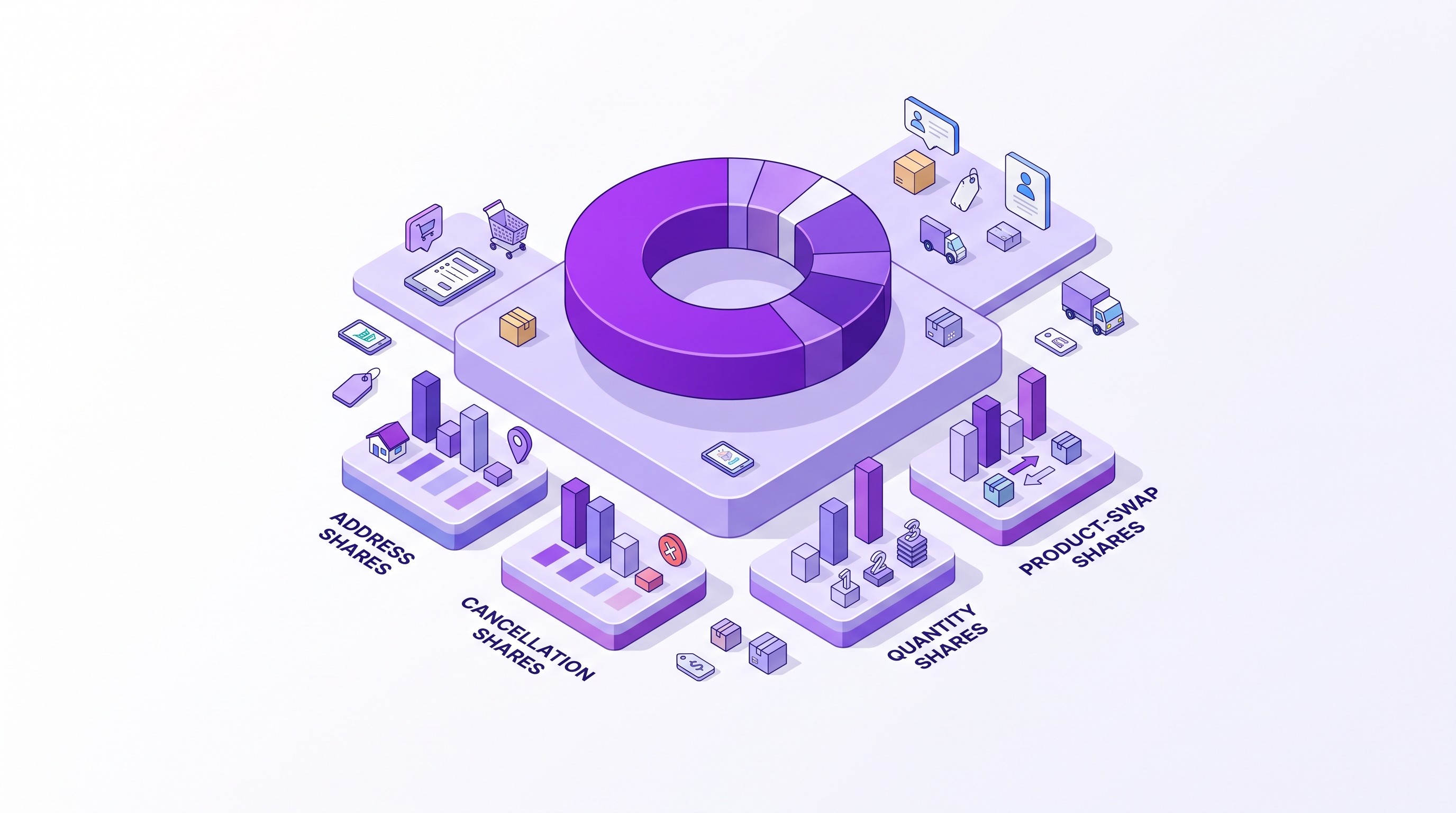
Shipping-address changes are the most common post-purchase edit, at 30.2% of all edited orders (Revize, 2026). That is 48,742 addresses corrected before the package shipped.
How often do customers cancel instead of edit?
Full cancellations account for 24.3% of edited orders, 39,142 in total (Revize, 2026). Cancellations are the second most common post-purchase action after address changes.
Every one of those is a sale that a swap or an address fix might have saved.
How often do customers change quantities or products?
Quantity changes account for 9.0% of edited orders and product additions for 8.8% (Revize, 2026). That is 14,533 and 14,265 orders respectively.
How often do customers accept a post-purchase upsell?
8.0% of edited orders include an accepted post-purchase upsell, 12,850 orders in total (Revize, 2026). Post-purchase editing is not purely a cost centre; it is also an AOV surface.
What share of edits are shipping-method changes?
Shipping-method updates account for 7.9% of edited orders, 12,752 in total (Revize, 2026).
How often do customers fix a phone number or email?
Phone-number updates account for 6.1% of edited orders and email updates for 2.5% (Revize, 2026). That is 9,826 and 4,058 orders respectively, contact details that would otherwise break delivery notifications.
How often do customers downgrade an order?
Order downgrades account for 3.3% of edited orders, 5,312 in total (Revize, 2026).
How often is a tax invoice requested?
Tax-invoice generation accounts for 1.7% of edited orders, 2,711 in total (Revize, 2026).
How often do customers apply a discount after checkout?
Post-checkout discount applications account for 0.75% of edited orders, 1,211 in total (Revize, 2026).
How often is a formal withdrawal requested?
Formal withdrawal requests account for 0.19% of edited orders, 304 in total (Revize, 2026). Low volume, high compliance stakes, particularly under EU cooling-off rules.
Grouped by intent, how does the split look?
Modifications account for 53.6% of edited orders, cancellations 24.5%, upsells 8.0%, and support escalations 7.8% (Revize, 2026). Modifications cover address, contact, product, shipping, and discount changes: 86,374 orders in total.
Most post-purchase activity is a customer trying to fix an order, not abandon it.
How Much Support Work Does Self-Service Remove?
What percentage of order edits are completed without a support agent?
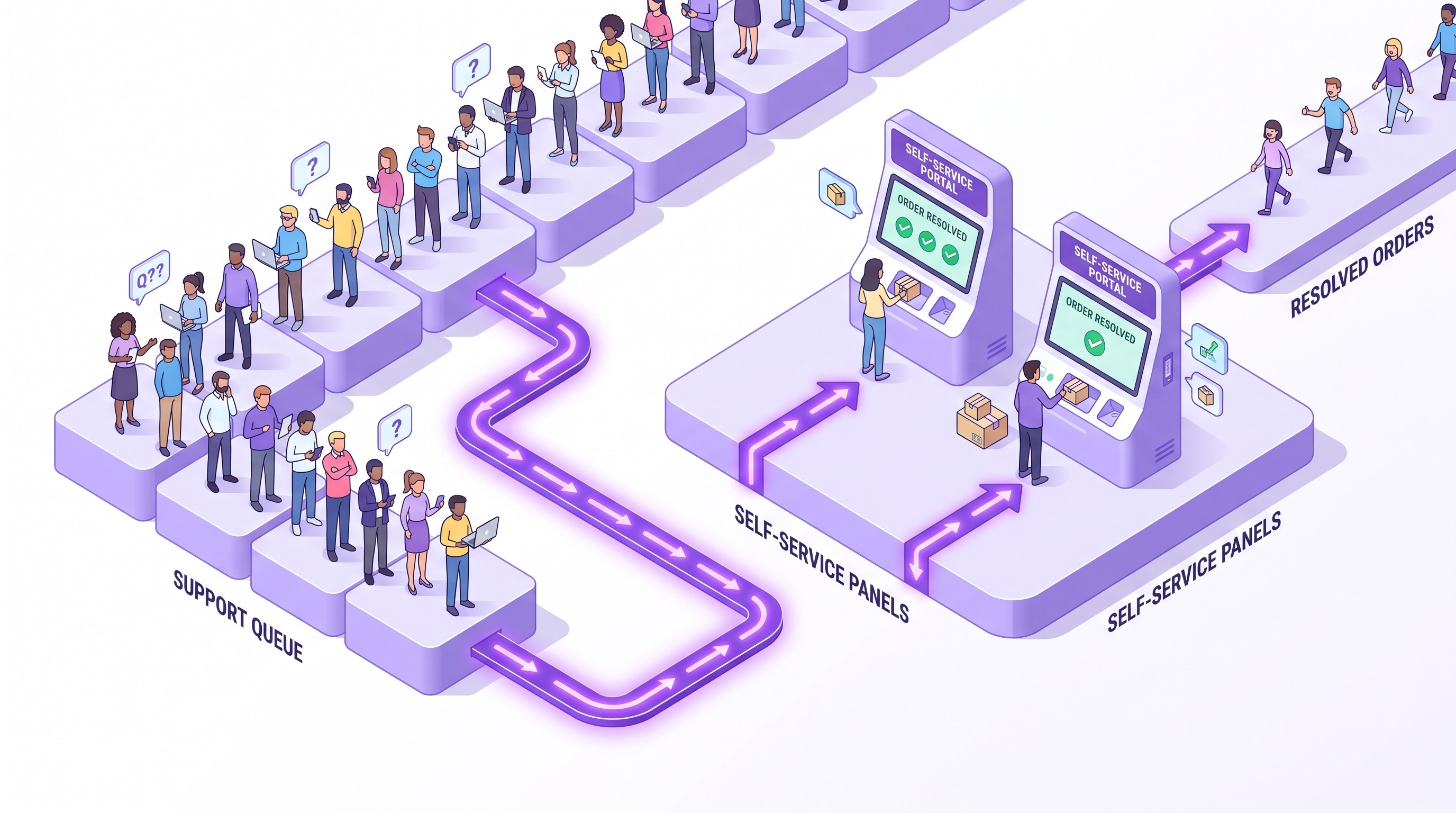
92.2% of post-purchase edits are completed by the customer with no support agent involved (Revize, 2026). Only 7.8% of edited orders escalated to support.
How many support escalations does that represent?
7.8% of edited orders escalate to a human, 12,584 in total (Revize, 2026). The rest resolved themselves.
How many wrong addresses were caught before shipping?
48,742 wrong shipping addresses were corrected before the package shipped (Revize, 2026). Each one is a reshipment, a "where is my order" thread, and potentially an undelivered-parcel dispute that never happened.
How many cancellations were handled without an agent?
39,142 cancellations were handled self-serve (Revize, 2026). Cancellation is the request most likely to sit in a queue and most likely to become a chargeback if it does.
How many post-purchase upsells were accepted?
12,865 post-purchase upsells were accepted across the dataset (Revize, 2026).
How many subscription line edits were handled?
12,881 orders involved subscription line edits (Revize, 2026).
Seasonality: When Does Editing Peak?
When do post-purchase edits peak during the year?
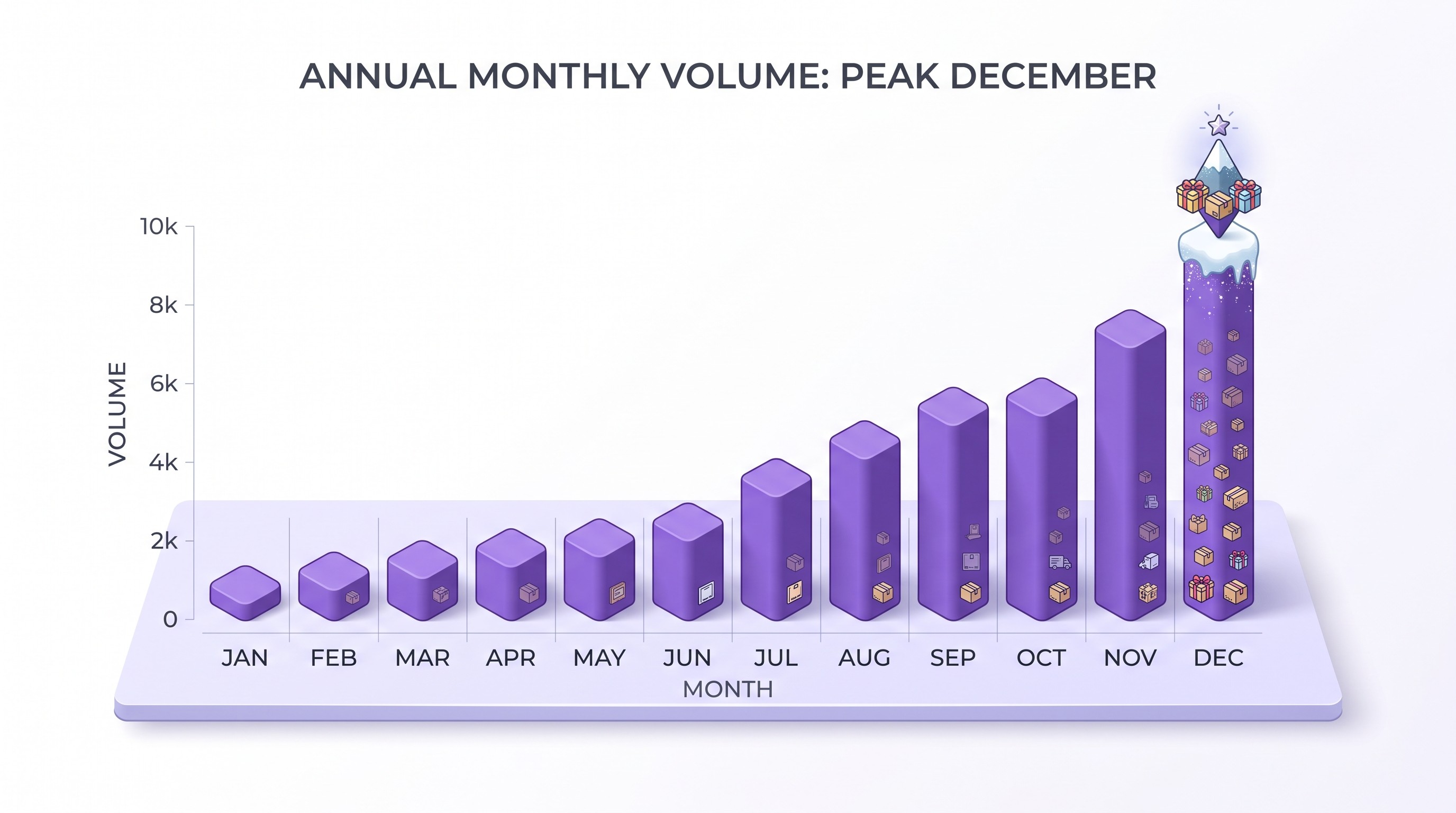
Edited orders peaked in December 2025 at 25,966, 2.4 times the November figure of 10,924 (Revize, 2026). January followed at 18,658 before settling to a 2026 range of roughly 11,700 to 17,800 per month.
Read this as a directional seasonal signal rather than a clean multiplier: the installed merchant base grew across the same period, so peak-season demand and platform growth both contribute.
What does the monthly trend look like?
Monthly edited orders rose from 3,371 in July 2025 to 17,824 in June 2026 (Revize, 2026). The trend reflects both adoption and underlying order growth.
What should merchants take from the seasonality data?
The December peak means post-purchase support load rises fastest exactly when your team has the least slack (Revize, 2026). Self-service capacity added before peak season is worth materially more than the same capacity added after it.
Methodology
Sample: 10 million+ Shopify orders. 2,806,265 edit-flow sessions were logged.
Edited order: an order with at least one committed post-checkout change (address, contact, product, quantity, shipping method, discount, cancellation, withdrawal, invoice, or accepted upsell).
Timing basis: the 4.6-minute median and the 1-hour and 24-hour figures are measured across 72,526 committed address, contact, and delivery edits, timed from order placement to edit commit. They are not modelled or estimated.
Self-serve rate: derived as edited orders minus orders that raised a support request, divided by edited orders.
Queries: index-bounded single-pass aggregates run with
default_transaction_read_only=onand a statement timeout, so production performance was unaffected.Known limitations: merchants are Revize customers, so they have self-service editing available, which a store without an editing tool does not. Percentages are shares of edited orders unless stated otherwise. The dataset spans multiple currencies (USD, AUD, INR, GBP, EUR, ZAR, ARS, JPY and others), so no aggregate revenue figure is published without FX normalization; revenue-adjacent findings are framed as counts. Seasonality is confounded with merchant-base growth, as noted above.
Cite These Statistics
These figures may be quoted with attribution. Suggested citation:
Revize (2026). Shopify Order Editing Statistics: 25+ Data Points from 10M+ Orders. https://revize.app/blog/shopify-order-editing-statistics
For journalists, analysts, or merchants who need a specific cut of this data that is not published here, the underlying aggregates are maintained quarterly.
Frequently Asked Questions
What percentage of Shopify orders are edited after checkout?
5.2% of Shopify orders are edited after checkout, about 1 in 19 (Revize, 2026). Across 10 million+ Shopify orders, that is the public baseline.
How quickly do customers edit their Shopify orders?
The median edit lands 4.6 minutes after checkout, and 80.6% occur within the first hour (Revize, 2026). A quarter arrive within 1.5 minutes. This front-loaded distribution is why a short fulfillment hold captures most changes without delaying dispatch.
What is the most common change customers make to an order?
Shipping-address changes, at 30.2% of edited orders (Revize, 2026). Full cancellations follow at 24.3%, then quantity changes at 9.0% and product additions at 8.8%. Address accuracy is the single highest-volume post-purchase problem on Shopify.
Can customers edit Shopify orders without contacting support?
Yes, and 92.2% of edits are completed with no agent involved (Revize, 2026). Native Shopify does not offer customer-facing order editing, so this requires a self-service app. Only 7.8% of edited orders escalated to a human in this dataset.
How many wrong addresses can self-service catch?
48,742 wrong shipping addresses were corrected before the package shipped in this dataset (Revize, 2026). Each correction avoids a reshipment, a delivery-status ticket, and a possible undelivered-parcel dispute.
Is post-purchase editing only a cost saving?
No. 8.0% of edited orders included an accepted post-purchase upsell, 12,850 orders in total (Revize, 2026). The same flow that fixes an address is also an AOV surface, so the business case is not purely deflection.
When is post-purchase support load highest?
Edited orders peaked in December 2025 at 25,966, 2.4 times November (Revize, 2026). The peak coincides with the period teams have least capacity, though the installed base also grew over the period, so treat it as directional.
Where do these numbers come from?
Revize's production dataset of 10 million+ Shopify orders (Revize, 2026). Headline rates are from the July 9, 2026 study. Full methodology, sample sizes, and limitations are documented in the Methodology section above.
Related Reading
These statistics come from Revize, the Shopify app that lets customers edit their own orders after checkout.
Quick answer: Across 10 million+ Shopify orders, 5.2% are edited after checkout (Revize, 2026). The median edit lands 4.6 minutes after the order is placed, and 92.2% are completed by the customer with no support agent involved. Shipping-address changes are the single most common edit at 30.2%.
Shopify Order Editing Statistics (2026): 25+ Data Points from 10M+ Orders
Nobody publishes a cross-store baseline for post-purchase order editing. Vendors quote single-brand case studies, and Shopify's own docs describe what is possible without saying how often it actually happens. This page is the missing baseline: every number below comes from Revize's production dataset of 10 million+ Shopify orders. Headline rates are from the July 9, 2026 study (Revize, 2026).
Use these figures freely with attribution. The methodology, sample sizes, and known limitations are documented at the bottom of the page.
Summary Table: The Headline Numbers
Statistic | Value | Basis |
|---|---|---|
Orders analyzed | 10 million+ | Shopify orders |
Post-checkout edit rate | 5.2% | about 1 in 19 orders |
Median time from checkout to edit | 4.6 minutes | 72,526 committed address/contact/delivery edits |
Edits within 1 hour | 80.6% | Same 72,526 edits |
Edits within 24 hours | 90.4% | Same 72,526 edits |
Completed by the customer, no agent | 92.2% | Share of edited orders; 7.8% escalate |
Most common edit: shipping address | 30.2% | 48,742 orders |
Second most common: full cancellation | 24.3% | 39,142 orders |
How Often Are Shopify Orders Edited After Checkout?
What percentage of Shopify orders get edited after checkout?
5.2% of Shopify orders are edited after checkout, or about 1 in 19 (Revize, 2026). Across 10 million+ Shopify orders, that rate is the public baseline.
It is a structural constant of post-purchase behavior, not a cherry-picked subset.
Has the edit rate changed over the past year?
The public baseline is 5.2% of orders edited after checkout, or about 1 in 19 (Revize, 2026). Across 10 million+ Shopify orders, that is the figure to cite.
Post-purchase edit demand is a structural constant of ecommerce, not a spike.
How Fast Do Customers Edit Their Orders?
How quickly do customers realize they made a mistake?
The median post-checkout edit lands 4.6 minutes after the order is placed (Revize, 2026). Measured across 72,526 committed address, contact, and delivery edits, from order placement to edit commit.
Customers notice almost immediately. The support ticket, by contrast, arrives whenever your team next opens the inbox.
What percentage of order edits happen within the first hour?
80.6% of order edits happen within the first hour of checkout (Revize, 2026). Within 24 hours, the figure reaches 90.4%.
This is the single most actionable number on this page: a fulfillment hold measured in minutes, not days, captures the overwhelming majority of changes.
How early is the fastest quartile?
25% of edits are committed within 1.5 minutes of checkout (Revize, 2026). The 75th percentile is 28.7 minutes.
The distribution is heavily front-loaded, which is why a short, well-placed edit window outperforms a long one.
What does this imply for a fulfillment hold?
A one-hour hold covers 80.6% of all post-checkout edits (Revize, 2026). Extending it to 24 hours adds only 9.8 percentage points.
The marginal return on a longer hold is small, and the cost in fulfillment delay is not.
What Do Customers Actually Change?
What is the most common post-purchase order edit?
Shipping-address changes are the most common post-purchase edit, at 30.2% of all edited orders (Revize, 2026). That is 48,742 addresses corrected before the package shipped.
How often do customers cancel instead of edit?
Full cancellations account for 24.3% of edited orders, 39,142 in total (Revize, 2026). Cancellations are the second most common post-purchase action after address changes.
Every one of those is a sale that a swap or an address fix might have saved.
How often do customers change quantities or products?
Quantity changes account for 9.0% of edited orders and product additions for 8.8% (Revize, 2026). That is 14,533 and 14,265 orders respectively.
How often do customers accept a post-purchase upsell?
8.0% of edited orders include an accepted post-purchase upsell, 12,850 orders in total (Revize, 2026). Post-purchase editing is not purely a cost centre; it is also an AOV surface.
What share of edits are shipping-method changes?
Shipping-method updates account for 7.9% of edited orders, 12,752 in total (Revize, 2026).
How often do customers fix a phone number or email?
Phone-number updates account for 6.1% of edited orders and email updates for 2.5% (Revize, 2026). That is 9,826 and 4,058 orders respectively, contact details that would otherwise break delivery notifications.
How often do customers downgrade an order?
Order downgrades account for 3.3% of edited orders, 5,312 in total (Revize, 2026).
How often is a tax invoice requested?
Tax-invoice generation accounts for 1.7% of edited orders, 2,711 in total (Revize, 2026).
How often do customers apply a discount after checkout?
Post-checkout discount applications account for 0.75% of edited orders, 1,211 in total (Revize, 2026).
How often is a formal withdrawal requested?
Formal withdrawal requests account for 0.19% of edited orders, 304 in total (Revize, 2026). Low volume, high compliance stakes, particularly under EU cooling-off rules.
Grouped by intent, how does the split look?
Modifications account for 53.6% of edited orders, cancellations 24.5%, upsells 8.0%, and support escalations 7.8% (Revize, 2026). Modifications cover address, contact, product, shipping, and discount changes: 86,374 orders in total.
Most post-purchase activity is a customer trying to fix an order, not abandon it.
How Much Support Work Does Self-Service Remove?
What percentage of order edits are completed without a support agent?
92.2% of post-purchase edits are completed by the customer with no support agent involved (Revize, 2026). Only 7.8% of edited orders escalated to support.
How many support escalations does that represent?
7.8% of edited orders escalate to a human, 12,584 in total (Revize, 2026). The rest resolved themselves.
How many wrong addresses were caught before shipping?
48,742 wrong shipping addresses were corrected before the package shipped (Revize, 2026). Each one is a reshipment, a "where is my order" thread, and potentially an undelivered-parcel dispute that never happened.
How many cancellations were handled without an agent?
39,142 cancellations were handled self-serve (Revize, 2026). Cancellation is the request most likely to sit in a queue and most likely to become a chargeback if it does.
How many post-purchase upsells were accepted?
12,865 post-purchase upsells were accepted across the dataset (Revize, 2026).
How many subscription line edits were handled?
12,881 orders involved subscription line edits (Revize, 2026).
Seasonality: When Does Editing Peak?
When do post-purchase edits peak during the year?
Edited orders peaked in December 2025 at 25,966, 2.4 times the November figure of 10,924 (Revize, 2026). January followed at 18,658 before settling to a 2026 range of roughly 11,700 to 17,800 per month.
Read this as a directional seasonal signal rather than a clean multiplier: the installed merchant base grew across the same period, so peak-season demand and platform growth both contribute.
What does the monthly trend look like?
Monthly edited orders rose from 3,371 in July 2025 to 17,824 in June 2026 (Revize, 2026). The trend reflects both adoption and underlying order growth.
What should merchants take from the seasonality data?
The December peak means post-purchase support load rises fastest exactly when your team has the least slack (Revize, 2026). Self-service capacity added before peak season is worth materially more than the same capacity added after it.
Methodology
Sample: 10 million+ Shopify orders. 2,806,265 edit-flow sessions were logged.
Edited order: an order with at least one committed post-checkout change (address, contact, product, quantity, shipping method, discount, cancellation, withdrawal, invoice, or accepted upsell).
Timing basis: the 4.6-minute median and the 1-hour and 24-hour figures are measured across 72,526 committed address, contact, and delivery edits, timed from order placement to edit commit. They are not modelled or estimated.
Self-serve rate: derived as edited orders minus orders that raised a support request, divided by edited orders.
Queries: index-bounded single-pass aggregates run with
default_transaction_read_only=onand a statement timeout, so production performance was unaffected.Known limitations: merchants are Revize customers, so they have self-service editing available, which a store without an editing tool does not. Percentages are shares of edited orders unless stated otherwise. The dataset spans multiple currencies (USD, AUD, INR, GBP, EUR, ZAR, ARS, JPY and others), so no aggregate revenue figure is published without FX normalization; revenue-adjacent findings are framed as counts. Seasonality is confounded with merchant-base growth, as noted above.
Cite These Statistics
These figures may be quoted with attribution. Suggested citation:
Revize (2026). Shopify Order Editing Statistics: 25+ Data Points from 10M+ Orders. https://revize.app/blog/shopify-order-editing-statistics
For journalists, analysts, or merchants who need a specific cut of this data that is not published here, the underlying aggregates are maintained quarterly.
Frequently Asked Questions
What percentage of Shopify orders are edited after checkout?
5.2% of Shopify orders are edited after checkout, about 1 in 19 (Revize, 2026). Across 10 million+ Shopify orders, that is the public baseline.
How quickly do customers edit their Shopify orders?
The median edit lands 4.6 minutes after checkout, and 80.6% occur within the first hour (Revize, 2026). A quarter arrive within 1.5 minutes. This front-loaded distribution is why a short fulfillment hold captures most changes without delaying dispatch.
What is the most common change customers make to an order?
Shipping-address changes, at 30.2% of edited orders (Revize, 2026). Full cancellations follow at 24.3%, then quantity changes at 9.0% and product additions at 8.8%. Address accuracy is the single highest-volume post-purchase problem on Shopify.
Can customers edit Shopify orders without contacting support?
Yes, and 92.2% of edits are completed with no agent involved (Revize, 2026). Native Shopify does not offer customer-facing order editing, so this requires a self-service app. Only 7.8% of edited orders escalated to a human in this dataset.
How many wrong addresses can self-service catch?
48,742 wrong shipping addresses were corrected before the package shipped in this dataset (Revize, 2026). Each correction avoids a reshipment, a delivery-status ticket, and a possible undelivered-parcel dispute.
Is post-purchase editing only a cost saving?
No. 8.0% of edited orders included an accepted post-purchase upsell, 12,850 orders in total (Revize, 2026). The same flow that fixes an address is also an AOV surface, so the business case is not purely deflection.
When is post-purchase support load highest?
Edited orders peaked in December 2025 at 25,966, 2.4 times November (Revize, 2026). The peak coincides with the period teams have least capacity, though the installed base also grew over the period, so treat it as directional.
Where do these numbers come from?
Revize's production dataset of 10 million+ Shopify orders (Revize, 2026). Headline rates are from the July 9, 2026 study. Full methodology, sample sizes, and limitations are documented in the Methodology section above.
Related Reading
These statistics come from Revize, the Shopify app that lets customers edit their own orders after checkout.


Revize your Shopify store. Lead with customer experience.

© Copyright 2026, All Rights Reserved
Revize your Shopify store. Lead with customer experience.
© Copyright 2026, All Rights Reserved
Revize your Shopify store. Lead with customer experience.
© Copyright 2026, All Rights Reserved
Revize your Shopify store. Lead with customer experience.
© Copyright 2026, All Rights Reserved