
Shopify Agentic Orders: The Ops Problem Nobody Discusses

Shopify Agentic Orders: The Ops Problem Nobody Discusses

Shopify Agentic Orders: The Ops Problem Nobody Discusses

Shopify Agentic Orders: The Ops Problem Nobody Discusses | Revize blog

Shopify agentic orders: the operator's 15-second read

  • The entire agentic commerce conversation is about acquisition. Get into ChatGPT, get AI traffic, get the order. Almost nobody is discussing what happens to that order afterward, even though across 7.6 million Shopify orders, about 1 in 47 (2.1%) is edited after checkout (Revize, 2026).

  • An AI-placed order breaks three assumptions your post-purchase flow is built on: the customer placed it, the customer recognizes it, the customer knows where to change it. All three are now false.

  • The webhook layer changed too. Shopify ships UCP-shaped webhooks for fulfillment, returns, refunds, and edits on agent orders. The events arrive; whether your stack does anything useful with them is on you.

  • This is not a tooling-purchase problem yet. Nobody in the ecosystem has a finished agent-order-aware post-purchase layer, us included. It is being built across the industry. What you can do now is instrument the problem before it scales.

  • The merchants who win agentic commerce will not be the ones with the best catalog feed. They will be the ones who kept the customer after the agent placed the order.

Shopify agentic orders are the most over-hyped and under-examined thing in commerce right now. Open X this week and every post is the same: agentic commerce is the future, get your store into ChatGPT, AI traffic is up 7x. All true. All acquisition. Zero of it is about the part that actually decides whether agentic commerce makes you money: what happens after the agent places the order.

We run a post-purchase order-editing app used across thousands of Shopify stores, so we spend our days on the after part. This is the operator view of agentic orders, written from that vantage point: what actually changes operationally, the webhook reality, the failure modes, and what to do before the volume scales. It is the companion to our strategic take in Shopify MCP in 2026: What Actually Works. That article argues which MCP surfaces matter. This one is about the problem all of them create and none of them solve.



Split scene of agentic commerce hype on one side and the quiet post-purchase operational problem on the other

The Acquisition Blind Spot

Here is the thing nobody hyping agentic commerce will say out loud: getting the order is the easy half. Shopify built Storefront MCP into every store. Agents can already discover your products and check out. That part is largely solved and it is what everyone is celebrating.

The unsolved half is everything after the order lands, and it is unsolved because the people loudest about agentic commerce are platform and tooling vendors whose job ends at the transaction. Ours does not. We see the second half, and the second half is where agentic commerce quietly breaks.

The blind spot, stated plainly: your entire post-purchase operation assumes the customer placed the order themselves. That assumption is now wrong on a growing share of orders, and almost nobody is adjusting for it.

What Actually Changes When an Agent Places the Order

Three assumptions your post-purchase flow is built on, and how each one breaks:

Assumption one: the customer placed the order, so they have the confirmation. On an agent order, the agent placed it. The customer may have a chat transcript, not your order confirmation email. They do not have your "manage order" link because they never landed on your thank-you page. The standard "click the link in your confirmation email" recovery path does not exist for them.

Assumption two: the customer recognizes the order. A customer who typed their own cart recognizes it. A customer who said "order me the usual" or "get the blue one" to an agent often does not recognize the order line items when they see the confirmation, because the agent made interpretation choices they did not see happen.

Assumption three: the customer knows where to change it. Customers who checked out on your site have muscle memory for your account area. A customer who transacted entirely inside ChatGPT has never seen your site. When something is wrong, they do not go to your site. They go back to the agent, which currently cannot edit a completed Shopify order, then they email you, usually frustrated, usually outside business hours.

None of this is hypothetical. These are the patterns we already see on AI-attributed orders, and the share of orders that are AI-attributed is climbing fast.



Three broken post-purchase assumptions on an agent-placed Shopify order: no confirmation, no recognition, no edit path

The Webhook Reality

This is the part with concrete mechanics, and it is where the operational work actually lives.

Shopify's agentic commerce docs introduce UCP-shaped webhooks. Order lifecycle events for fulfillment, returns, refunds, and edits are emitted in the UCP shape so an agent (or your systems) can subscribe and react. The get_order tool exists for on-demand state. The infrastructure for knowing what happened to an agent order is there.

What the infrastructure does not do is decide what is operationally important. That is the trap. The events arrive. Whether your stack distinguishes an agent-placed order from a human-placed one, and whether it routes the agent ones differently, is entirely on you. Out of the box, an agent order looks like any other order in your admin. It is not any other order, and treating it identically is the mistake.

The operationally useful move is to tag agent-attributed orders at ingestion and treat that tag as a first-class routing signal everywhere downstream: fulfillment review, support triage, edit windows, and returns. If you cannot answer "how many of yesterday's orders were agent-placed and how many of those generated a change request," you do not yet have visibility into the problem, and you cannot manage what you cannot see.



Shopify order webhook events arriving from an agent order and being routed differently from human orders

The Four Failure Modes We Already See

Concrete, from what lands in front of post-purchase teams today:

Address parsing errors. The agent resolved "ship to my office" or "send it to mom's" to a saved address, sometimes the wrong one. The customer notices an hour later. On human orders this is rare because the customer typed and saw the address. On agent orders it is materially more common because a model interpreted an instruction.

Variant mismatches. "The blue one" became a blue variant, not the blue the customer meant. "The big size" became XL when they meant L. The agent had to pick; the customer did not watch it pick.

Quantity misunderstandings. "Get a couple" became 2 when they meant a few. "One for everyone" became 1 when they meant per person. Natural language is ambiguous and the agent committed to a number.

No edit relationship. The cumulative effect of the three broken assumptions. The customer wants to fix one of the above, has no confirmation link, has never seen your site, and the agent cannot edit a completed order. So they email. Every one of these is a support ticket that a self-service path would have absorbed, except the self-service path was designed for customers who came through your site.

Why Your Current Post-Purchase Flow Cannot Catch This

Most stores' post-purchase setup is some combination of: edit link in the confirmation email, a customer account area, and a support inbox. Every layer of that assumes site contact. The confirmation email assumes they open it. The account area assumes they log into your site. The support inbox is the fallback, and on agent orders it is not a fallback, it is the only path, which means agent orders concentrate disproportionately into your most expensive channel.

The honest framing of the gap: this is a post-purchase editing problem at its root, which is the category we work in at Revize. Being straight with you, because the rest of this space is not: nobody in the ecosystem has a finished agent-order-aware post-purchase layer yet, Revize included. It is being built, across the industry and by us. The useful thing today is not buying a solution. It is instrumenting the problem so you see it before it scales, and getting your general post-purchase self-service solid so the agent-order spike has somewhere to land that is not your inbox.

What to Instrument This Week

This is the actionable part, and it is deliberately tool-agnostic because the tooling does not exist yet and you should not wait for it:

  1. Tag agent-attributed orders at ingestion. Shopify exposes attribution metadata on agent orders. Capture it and write it to an order tag or metafield the moment the order is created. Everything else depends on this.

  2. Build one report: agent orders per day, and what share of them generated a change request or support contact within 72 hours. This single number tells you whether you have a problem yet and how fast it is growing.

  3. Route agent orders to a wider edit window. They are more error-prone at placement, so the customer needs longer to catch it. If your edit window is 30 minutes, agent orders specifically should get more.

  4. Pre-write the support macros for the four failure modes above. They are predictable. Your team should not be improvising the address-parsing-error reply at 11pm.

  5. Audit your confirmation flow for a no-email path. Assume the customer does not have your confirmation email. Is there any way for an order to be found and changed that does not start with that email? If not, that is the gap to close first.

None of this requires a vendor. All of it requires deciding agent orders are a distinct operational class, which is the entire point.
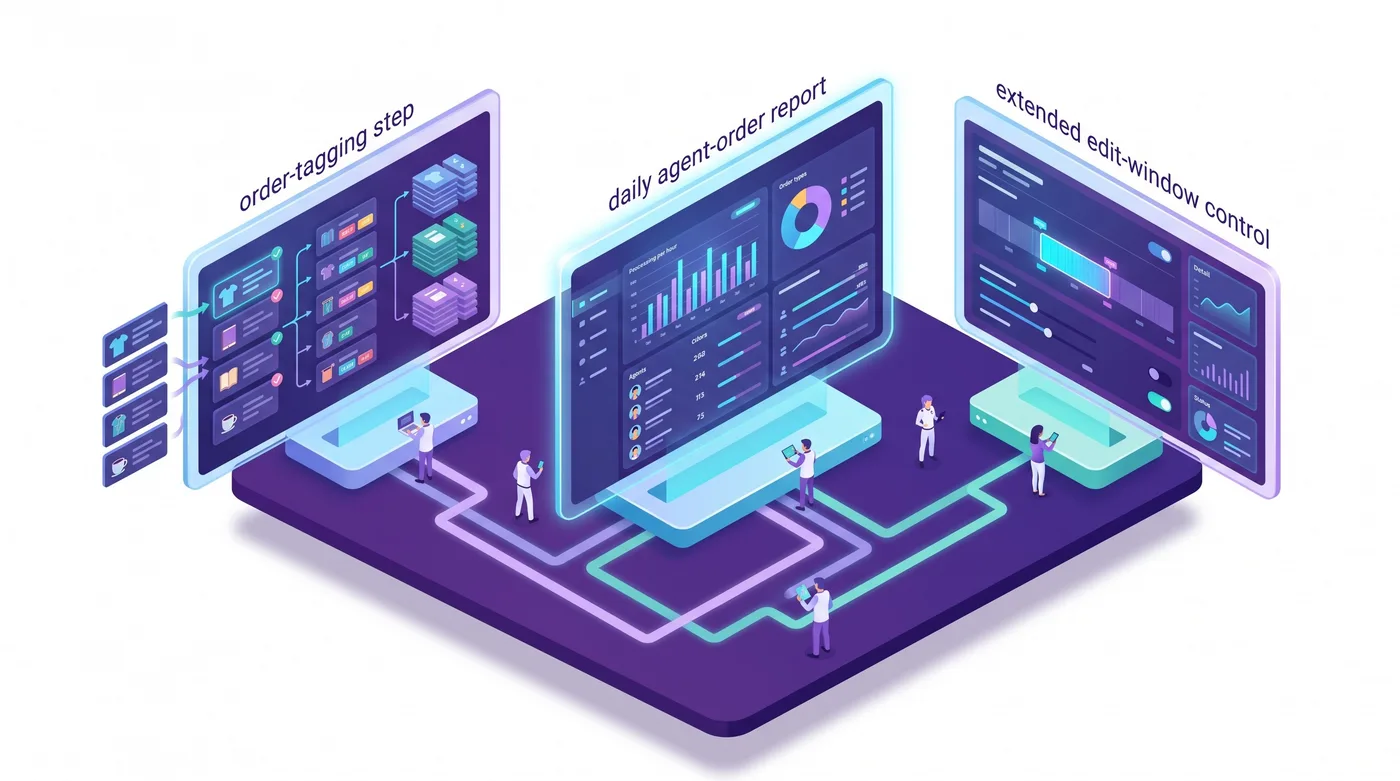


Operations team instrumenting agent order tracking with tagging reporting and wider edit windows

Where the Tooling Actually Is (Honest Version)

Since every other article on this topic is selling something, here is the unsold version.

Shopify's side is genuinely shipped: the webhooks exist, the attribution exists, the get_order tool exists. The platform did its part. What does not exist yet, anywhere, is a post-purchase layer that understands an agent order is different and adapts the editing experience for a customer who never visited your site. The whole category, us included, is building toward it. Anyone telling you they have a complete agentic post-purchase solution today is ahead of the truth.

That is not a reason to wait. It is the opposite. The instrumentation above is free, it is available now, and the merchants who do it will have a year of data and operational muscle before the merchants who waited for a product even start. Agentic commerce will reward the operators who treated the after as seriously as the platform vendors treated the during.

The Bottom Line

The agentic commerce wave is real and the acquisition story is true. It is also only half the story, and it is the half everyone is telling because the people telling it stop caring at the transaction. The operator who is still there after the transaction sees the other half: agent orders break the assumptions your post-purchase operation is built on, they concentrate into your most expensive support channel, and the tooling to handle them properly does not exist yet.

What to do this week:

  1. Tag agent-attributed orders at ingestion

  2. Build the one report: agent orders per day and their 72-hour change rate

  3. Widen the edit window for agent orders specifically

  4. Pre-write the four support macros

  5. Find your no-confirmation-email recovery path, or build one



Shopify merchant who instrumented agentic order operations early holding an advantage over competitors who waited

Frequently Asked Questions

What is an agentic order on Shopify?

An agentic order is one placed by an AI agent (ChatGPT, Perplexity, a custom agent) on a buyer's behalf through Shopify's MCP and UCP infrastructure, rather than the customer checking out on your site themselves. Operationally it lands in your admin like any order, but the customer never saw your checkout, may not have your confirmation email, and often never visited your site.

Why are agent orders harder to support than normal orders?

Because your post-purchase flow assumes the customer placed the order, recognizes it, and knows where to change it. On agent orders all three are frequently false. The customer interacted with an agent, not your site, so the standard recovery paths (confirmation-email link, account area) do not work for them and they default to your support inbox.

What webhooks does Shopify provide for agentic orders?

Shopify emits UCP-shaped webhooks for order lifecycle events including fulfillment, returns, refunds, and edits, plus a get_order tool for on-demand state. The events are available; deciding to treat agent orders as a distinct operational class and routing them differently is the merchant's responsibility, not something the webhooks do automatically.

How do I identify which orders were placed by an AI agent?

Shopify exposes attribution metadata on agent-placed orders. The practical move is to capture that metadata at order creation and write it to an order tag or metafield immediately, so every downstream system (fulfillment, support, returns, reporting) can treat agent orders distinctly. Without this tag you have no visibility into the problem.

What are the most common agent-order errors?

Four recurring patterns: address parsing errors (the agent resolved a vague instruction to the wrong saved address), variant mismatches (the agent picked an interpretation the customer did not intend), quantity misunderstandings (natural-language ambiguity committed to a wrong number), and no edit relationship (the customer cannot find a way to fix any of the above without emailing).

Does Revize handle agentic orders today?

Being honest: not as a dedicated agentic layer, and no one in the ecosystem has a finished one yet. Revize is a post-purchase order-editing app, which is the category this problem lives in, and agent-order-aware editing is something the industry, us included, is building toward. Today the useful action is instrumenting the problem and getting general post-purchase self-service solid, not waiting for an agent-specific product.

Should I wait for tooling before doing anything about agent orders?

No. The instrumentation steps (tagging agent orders, building the change-rate report, widening edit windows, pre-writing macros, finding a no-email recovery path) cost nothing, are available now, and compound. Merchants who instrument now will have a year of data and operational habit before merchants who waited for a product even begin.

How big is the agent-order volume actually?

Shopify reported AI traffic up 7x and AI-attributed orders up 11x since January 2025 (Q3 2025 earnings). The exact share varies by store and category, which is precisely why step one is building the report: you need your own number, not an industry average, to know how urgent this is for you specifically.

Will widening the edit window cause fulfillment problems?

It is a trade-off you manage, not avoid. Agent orders are more error-prone at placement, so a longer customer-side edit window catches more errors before they ship, which reduces returns and reships. The cost is a slightly later fulfillment start on those orders. For most stores the returns reduction outweighs the fulfillment delay; measure it on your own data.

How does this relate to Shopify MCP?

MCP is how the agent places the order; this is what happens to the order afterward. Our Shopify MCP guide covers which MCP surfaces matter strategically. This article is the operational companion: the MCP layer creates the agent order, and nothing in the MCP stack handles the post-purchase change the customer needs next.

What is the single highest-value thing to do first?

Tag agent-attributed orders at ingestion. Everything else (the report, the routing, the wider window, the macros) depends on being able to tell an agent order from a human one. Most stores cannot do this today, which means they are flying blind on a growing share of their orders.

Related Articles

Pairs with this take on Shopify agentic orders and the post-purchase reality:

Updated August 2026. Revize is a Shopify app for customer self-serve post-purchase order editing, letting shoppers change the shipping address, swap a variant or product, cancel, and get a refund or store credit before fulfillment, without a support ticket. Learn more about letting customers edit their own Shopify orders, or find Revize on the Shopify App Store.

Shopify agentic orders: the operator's 15-second read

  • The entire agentic commerce conversation is about acquisition. Get into ChatGPT, get AI traffic, get the order. Almost nobody is discussing what happens to that order afterward, even though across 7.6 million Shopify orders, about 1 in 47 (2.1%) is edited after checkout (Revize, 2026).

  • An AI-placed order breaks three assumptions your post-purchase flow is built on: the customer placed it, the customer recognizes it, the customer knows where to change it. All three are now false.

  • The webhook layer changed too. Shopify ships UCP-shaped webhooks for fulfillment, returns, refunds, and edits on agent orders. The events arrive; whether your stack does anything useful with them is on you.

  • This is not a tooling-purchase problem yet. Nobody in the ecosystem has a finished agent-order-aware post-purchase layer, us included. It is being built across the industry. What you can do now is instrument the problem before it scales.

  • The merchants who win agentic commerce will not be the ones with the best catalog feed. They will be the ones who kept the customer after the agent placed the order.

Shopify agentic orders are the most over-hyped and under-examined thing in commerce right now. Open X this week and every post is the same: agentic commerce is the future, get your store into ChatGPT, AI traffic is up 7x. All true. All acquisition. Zero of it is about the part that actually decides whether agentic commerce makes you money: what happens after the agent places the order.

We run a post-purchase order-editing app used across thousands of Shopify stores, so we spend our days on the after part. This is the operator view of agentic orders, written from that vantage point: what actually changes operationally, the webhook reality, the failure modes, and what to do before the volume scales. It is the companion to our strategic take in Shopify MCP in 2026: What Actually Works. That article argues which MCP surfaces matter. This one is about the problem all of them create and none of them solve.


Split scene of agentic commerce hype on one side and the quiet post-purchase operational problem on the other

The Acquisition Blind Spot

Here is the thing nobody hyping agentic commerce will say out loud: getting the order is the easy half. Shopify built Storefront MCP into every store. Agents can already discover your products and check out. That part is largely solved and it is what everyone is celebrating.

The unsolved half is everything after the order lands, and it is unsolved because the people loudest about agentic commerce are platform and tooling vendors whose job ends at the transaction. Ours does not. We see the second half, and the second half is where agentic commerce quietly breaks.

The blind spot, stated plainly: your entire post-purchase operation assumes the customer placed the order themselves. That assumption is now wrong on a growing share of orders, and almost nobody is adjusting for it.

What Actually Changes When an Agent Places the Order

Three assumptions your post-purchase flow is built on, and how each one breaks:

Assumption one: the customer placed the order, so they have the confirmation. On an agent order, the agent placed it. The customer may have a chat transcript, not your order confirmation email. They do not have your "manage order" link because they never landed on your thank-you page. The standard "click the link in your confirmation email" recovery path does not exist for them.

Assumption two: the customer recognizes the order. A customer who typed their own cart recognizes it. A customer who said "order me the usual" or "get the blue one" to an agent often does not recognize the order line items when they see the confirmation, because the agent made interpretation choices they did not see happen.

Assumption three: the customer knows where to change it. Customers who checked out on your site have muscle memory for your account area. A customer who transacted entirely inside ChatGPT has never seen your site. When something is wrong, they do not go to your site. They go back to the agent, which currently cannot edit a completed Shopify order, then they email you, usually frustrated, usually outside business hours.

None of this is hypothetical. These are the patterns we already see on AI-attributed orders, and the share of orders that are AI-attributed is climbing fast.


Three broken post-purchase assumptions on an agent-placed Shopify order: no confirmation, no recognition, no edit path

The Webhook Reality

This is the part with concrete mechanics, and it is where the operational work actually lives.

Shopify's agentic commerce docs introduce UCP-shaped webhooks. Order lifecycle events for fulfillment, returns, refunds, and edits are emitted in the UCP shape so an agent (or your systems) can subscribe and react. The get_order tool exists for on-demand state. The infrastructure for knowing what happened to an agent order is there.

What the infrastructure does not do is decide what is operationally important. That is the trap. The events arrive. Whether your stack distinguishes an agent-placed order from a human-placed one, and whether it routes the agent ones differently, is entirely on you. Out of the box, an agent order looks like any other order in your admin. It is not any other order, and treating it identically is the mistake.

The operationally useful move is to tag agent-attributed orders at ingestion and treat that tag as a first-class routing signal everywhere downstream: fulfillment review, support triage, edit windows, and returns. If you cannot answer "how many of yesterday's orders were agent-placed and how many of those generated a change request," you do not yet have visibility into the problem, and you cannot manage what you cannot see.


Shopify order webhook events arriving from an agent order and being routed differently from human orders

The Four Failure Modes We Already See

Concrete, from what lands in front of post-purchase teams today:

Address parsing errors. The agent resolved "ship to my office" or "send it to mom's" to a saved address, sometimes the wrong one. The customer notices an hour later. On human orders this is rare because the customer typed and saw the address. On agent orders it is materially more common because a model interpreted an instruction.

Variant mismatches. "The blue one" became a blue variant, not the blue the customer meant. "The big size" became XL when they meant L. The agent had to pick; the customer did not watch it pick.

Quantity misunderstandings. "Get a couple" became 2 when they meant a few. "One for everyone" became 1 when they meant per person. Natural language is ambiguous and the agent committed to a number.

No edit relationship. The cumulative effect of the three broken assumptions. The customer wants to fix one of the above, has no confirmation link, has never seen your site, and the agent cannot edit a completed order. So they email. Every one of these is a support ticket that a self-service path would have absorbed, except the self-service path was designed for customers who came through your site.

Why Your Current Post-Purchase Flow Cannot Catch This

Most stores' post-purchase setup is some combination of: edit link in the confirmation email, a customer account area, and a support inbox. Every layer of that assumes site contact. The confirmation email assumes they open it. The account area assumes they log into your site. The support inbox is the fallback, and on agent orders it is not a fallback, it is the only path, which means agent orders concentrate disproportionately into your most expensive channel.

The honest framing of the gap: this is a post-purchase editing problem at its root, which is the category we work in at Revize. Being straight with you, because the rest of this space is not: nobody in the ecosystem has a finished agent-order-aware post-purchase layer yet, Revize included. It is being built, across the industry and by us. The useful thing today is not buying a solution. It is instrumenting the problem so you see it before it scales, and getting your general post-purchase self-service solid so the agent-order spike has somewhere to land that is not your inbox.

What to Instrument This Week

This is the actionable part, and it is deliberately tool-agnostic because the tooling does not exist yet and you should not wait for it:

  1. Tag agent-attributed orders at ingestion. Shopify exposes attribution metadata on agent orders. Capture it and write it to an order tag or metafield the moment the order is created. Everything else depends on this.

  2. Build one report: agent orders per day, and what share of them generated a change request or support contact within 72 hours. This single number tells you whether you have a problem yet and how fast it is growing.

  3. Route agent orders to a wider edit window. They are more error-prone at placement, so the customer needs longer to catch it. If your edit window is 30 minutes, agent orders specifically should get more.

  4. Pre-write the support macros for the four failure modes above. They are predictable. Your team should not be improvising the address-parsing-error reply at 11pm.

  5. Audit your confirmation flow for a no-email path. Assume the customer does not have your confirmation email. Is there any way for an order to be found and changed that does not start with that email? If not, that is the gap to close first.

None of this requires a vendor. All of it requires deciding agent orders are a distinct operational class, which is the entire point.


Operations team instrumenting agent order tracking with tagging reporting and wider edit windows

Where the Tooling Actually Is (Honest Version)

Since every other article on this topic is selling something, here is the unsold version.

Shopify's side is genuinely shipped: the webhooks exist, the attribution exists, the get_order tool exists. The platform did its part. What does not exist yet, anywhere, is a post-purchase layer that understands an agent order is different and adapts the editing experience for a customer who never visited your site. The whole category, us included, is building toward it. Anyone telling you they have a complete agentic post-purchase solution today is ahead of the truth.

That is not a reason to wait. It is the opposite. The instrumentation above is free, it is available now, and the merchants who do it will have a year of data and operational muscle before the merchants who waited for a product even start. Agentic commerce will reward the operators who treated the after as seriously as the platform vendors treated the during.

The Bottom Line

The agentic commerce wave is real and the acquisition story is true. It is also only half the story, and it is the half everyone is telling because the people telling it stop caring at the transaction. The operator who is still there after the transaction sees the other half: agent orders break the assumptions your post-purchase operation is built on, they concentrate into your most expensive support channel, and the tooling to handle them properly does not exist yet.

What to do this week:

  1. Tag agent-attributed orders at ingestion

  2. Build the one report: agent orders per day and their 72-hour change rate

  3. Widen the edit window for agent orders specifically

  4. Pre-write the four support macros

  5. Find your no-confirmation-email recovery path, or build one


Shopify merchant who instrumented agentic order operations early holding an advantage over competitors who waited

Frequently Asked Questions

What is an agentic order on Shopify?

An agentic order is one placed by an AI agent (ChatGPT, Perplexity, a custom agent) on a buyer's behalf through Shopify's MCP and UCP infrastructure, rather than the customer checking out on your site themselves. Operationally it lands in your admin like any order, but the customer never saw your checkout, may not have your confirmation email, and often never visited your site.

Why are agent orders harder to support than normal orders?

Because your post-purchase flow assumes the customer placed the order, recognizes it, and knows where to change it. On agent orders all three are frequently false. The customer interacted with an agent, not your site, so the standard recovery paths (confirmation-email link, account area) do not work for them and they default to your support inbox.

What webhooks does Shopify provide for agentic orders?

Shopify emits UCP-shaped webhooks for order lifecycle events including fulfillment, returns, refunds, and edits, plus a get_order tool for on-demand state. The events are available; deciding to treat agent orders as a distinct operational class and routing them differently is the merchant's responsibility, not something the webhooks do automatically.

How do I identify which orders were placed by an AI agent?

Shopify exposes attribution metadata on agent-placed orders. The practical move is to capture that metadata at order creation and write it to an order tag or metafield immediately, so every downstream system (fulfillment, support, returns, reporting) can treat agent orders distinctly. Without this tag you have no visibility into the problem.

What are the most common agent-order errors?

Four recurring patterns: address parsing errors (the agent resolved a vague instruction to the wrong saved address), variant mismatches (the agent picked an interpretation the customer did not intend), quantity misunderstandings (natural-language ambiguity committed to a wrong number), and no edit relationship (the customer cannot find a way to fix any of the above without emailing).

Does Revize handle agentic orders today?

Being honest: not as a dedicated agentic layer, and no one in the ecosystem has a finished one yet. Revize is a post-purchase order-editing app, which is the category this problem lives in, and agent-order-aware editing is something the industry, us included, is building toward. Today the useful action is instrumenting the problem and getting general post-purchase self-service solid, not waiting for an agent-specific product.

Should I wait for tooling before doing anything about agent orders?

No. The instrumentation steps (tagging agent orders, building the change-rate report, widening edit windows, pre-writing macros, finding a no-email recovery path) cost nothing, are available now, and compound. Merchants who instrument now will have a year of data and operational habit before merchants who waited for a product even begin.

How big is the agent-order volume actually?

Shopify reported AI traffic up 7x and AI-attributed orders up 11x since January 2025 (Q3 2025 earnings). The exact share varies by store and category, which is precisely why step one is building the report: you need your own number, not an industry average, to know how urgent this is for you specifically.

Will widening the edit window cause fulfillment problems?

It is a trade-off you manage, not avoid. Agent orders are more error-prone at placement, so a longer customer-side edit window catches more errors before they ship, which reduces returns and reships. The cost is a slightly later fulfillment start on those orders. For most stores the returns reduction outweighs the fulfillment delay; measure it on your own data.

How does this relate to Shopify MCP?

MCP is how the agent places the order; this is what happens to the order afterward. Our Shopify MCP guide covers which MCP surfaces matter strategically. This article is the operational companion: the MCP layer creates the agent order, and nothing in the MCP stack handles the post-purchase change the customer needs next.

What is the single highest-value thing to do first?

Tag agent-attributed orders at ingestion. Everything else (the report, the routing, the wider window, the macros) depends on being able to tell an agent order from a human one. Most stores cannot do this today, which means they are flying blind on a growing share of their orders.

Related Articles

Pairs with this take on Shopify agentic orders and the post-purchase reality:

Updated August 2026. Revize is a Shopify app for customer self-serve post-purchase order editing, letting shoppers change the shipping address, swap a variant or product, cancel, and get a refund or store credit before fulfillment, without a support ticket. Learn more about letting customers edit their own Shopify orders, or find Revize on the Shopify App Store.

Revize your Shopify store. Lead with customer experience.

© Copyright 2026, All Rights Reserved

Revize your Shopify store. Lead with customer experience.

© Copyright 2026, All Rights Reserved

Revize your Shopify store. Lead with customer experience.

© Copyright 2026, All Rights Reserved

Revize your Shopify store. Lead with customer experience.

© Copyright 2026, All Rights Reserved