
Zero-Ticket Order Changes: Customer Self-Serve vs AI Agent Deflection on Shopify

Zero-Ticket Order Changes: Customer Self-Serve vs AI Agent Deflection on Shopify

Zero-Ticket Order Changes: Customer Self-Serve vs AI Agent Deflection on Shopify

Zero-Ticket Order Changes: Customer Self-Serve vs AI Agent Deflection on Shopify — Revize blog article header

Quick answer: The most direct way to reduce order-change tickets on Shopify is to let the customer make the change themselves, so the ticket never exists. In Revize's dataset, 92.2% of post-purchase edits are completed by the customer with no support agent involved (Revize, 2026), and the median edit lands 4.6 minutes after checkout, with no ticket queue required.

For high-volume Shopify Plus stores, every order-change ticket that reaches a human costs agent minutes and risks a response the customer won't wait for. AI agents bolted onto the help desk can resolve that ticket without a human, but they still need the ticket to exist first. In Revize's dataset of 10 million+ Shopify orders, about 1 in 19 (5.2%) gets edited after checkout (Revize, 2026), which means the real question isn't "how fast can support handle this," it's "does support need to touch it at all."

This piece breaks down the deflection-versus-elimination debate in plain terms, how AI agents and customer self-serve actually work for order changes, and what the data says about which model empties the support queue faster. It's written for the ops lead deciding where to spend next quarter's support budget, and for the developer or agency who has to wire up whichever model wins.
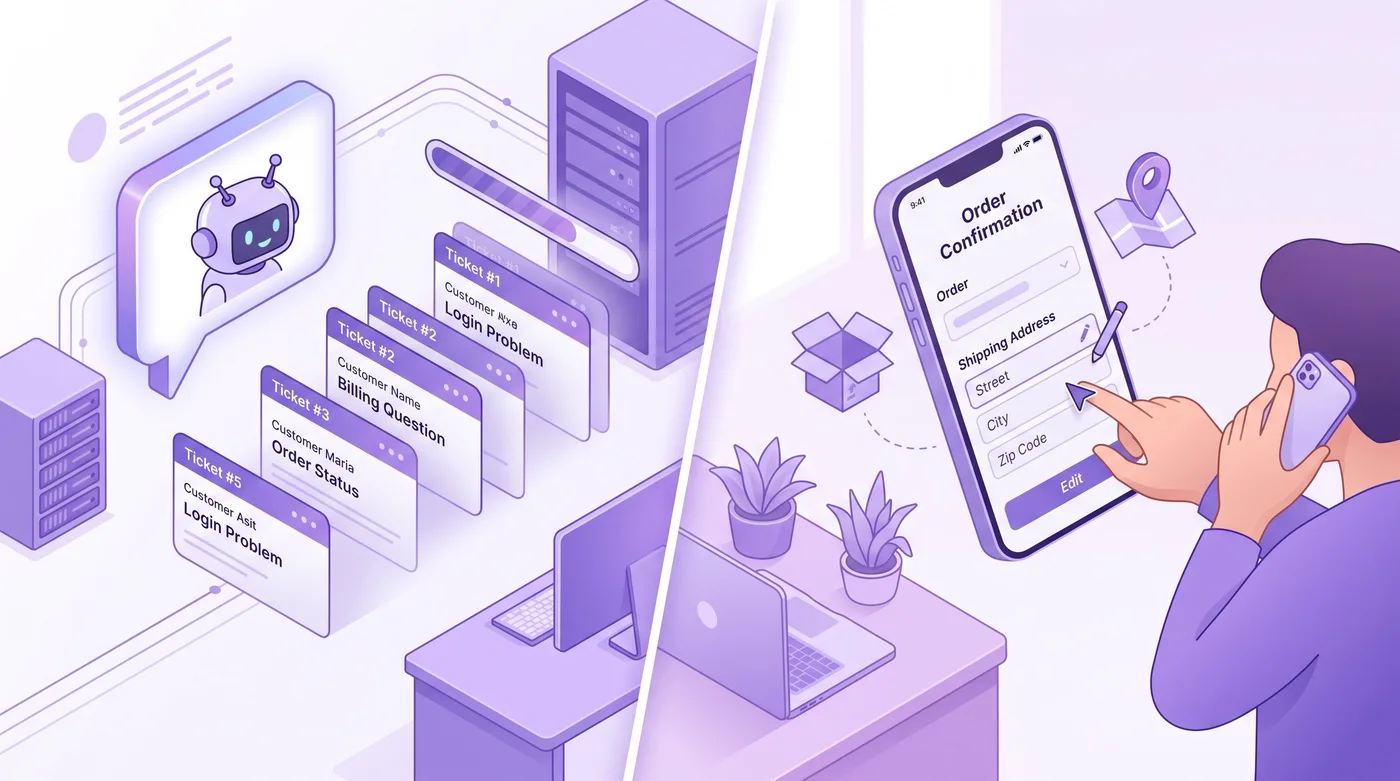

split scene AI support agent versus customer self-serve order edit

What "Zero-Ticket" Actually Means for Order Changes

Zero-ticket means the support ticket is never created, not that it gets answered quickly. That distinction matters more than it sounds like it should.

Think of it like the difference between a fast self-checkout lane and a store clerk who answers your question in ten seconds flat. Both get you out of the store quickly, but only one of them means the store never had to staff the question in the first place. "Deflection" is the clerk answering fast. "Elimination" is the self-checkout lane existing at all.

Deflection metrics count tickets closed by a bot without human escalation. That's a real efficiency gain over a human answering every ticket cold. But it's a different category of outcome than a customer never opening a ticket because they changed their own shipping address, swapped a variant, or canceled the order themselves, directly on the order.

Deflection vs. Resolution: The Support Metric Debate

Ticket deflection rate looks great on a dashboard and can still hide a growing queue. Suppose an AI agent resolves most order-change tickets without a human. That is genuinely useful, and it's also still processing 100% of the ticket volume: every one of those requests still had to be typed, categorized, routed, and logged somewhere.

This is the argument playing out across CX teams right now, and it's worth being blunt about where each model wins.

AI agent deflection wins on speed-per-ticket. If a customer is already in a chat widget asking "can you change my address," an AI agent that reads the order, confirms the request, and executes the change in the same conversation is a real improvement over a human agent doing the same thing an hour later. That's not a knock on the category, it's the honest strength of it.

Self-serve wins on ticket volume, because it removes the step where a ticket gets typed at all. If the customer can make the same address change from a link in their order confirmation email, in the same 60 seconds it would have taken to open a chat window, the ticket never enters the queue, the AI agent never gets invoked, and nobody has to build a resolution-quality benchmark for it.

Neither model is wrong. But only one of them is measured by tickets avoided instead of tickets answered, and that's the metric that actually predicts headcount.
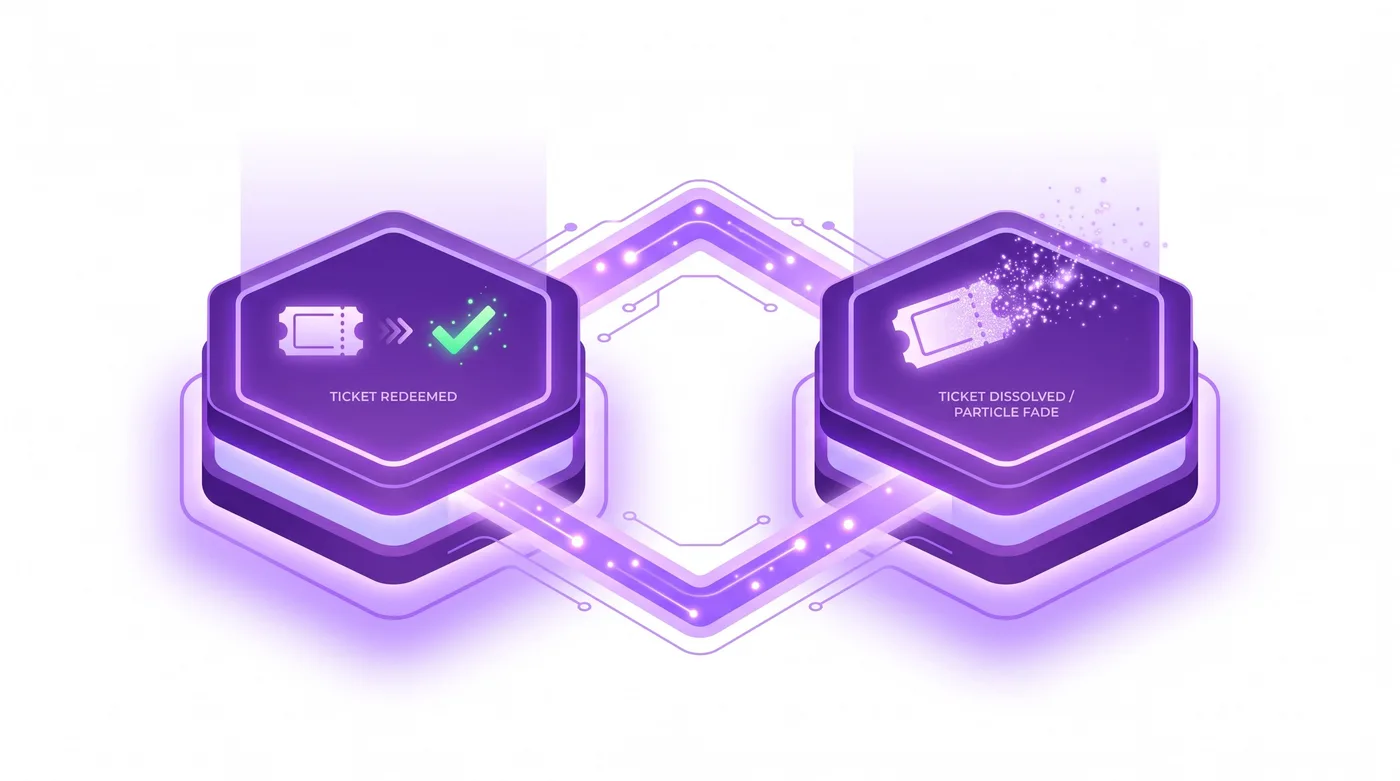

glowing hexagonal hub comparing deflection versus elimination models

How AI Order-Change Agents Work Today

AI support agents read a ticket, classify the request, and call the underlying commerce platform's APIs to execute simple actions like an address change or a cancellation. Help-desk AI agents sit on top of the help desk this way: the customer still opens a conversation, the AI parses intent from that conversation, pulls the order, and (where the platform allows it) makes the change or hands off to a human when the request falls outside its guardrails.

In plain terms: this is a faster, cheaper version of a human agent doing the same lookup-and-edit work, still triggered by a ticket, still logged as a support interaction, still requiring the merchant to run a help desk workflow for order changes at all.

That's a meaningful upgrade for merchants whose support volume is dominated by complex, judgment-heavy tickets where a human (or an AI standing in for one) genuinely needs to read the conversation. It's a less obvious upgrade for the highest-volume, lowest-complexity request in most Shopify stores: "I need to change something on the order I just placed."

How Customer Self-Serve Works for Order Changes

Customer self-serve removes the conversation step entirely: the customer acts on the order directly, without describing the request to anyone first. Revize is built around that model. The customer starts from their order confirmation email, the same email they already open to check their order, and from there can change a shipping address, change a variant or quantity, switch products (on the Pro plan), cancel, or request a refund on their own (see the order confirmation email setup).

The merchant still controls the guardrails. Order-edit restrictions set which orders and changes are allowed, the edit window sets how long after checkout, and order-processing rules determine how the edit flows into fulfillment once it's made. Nothing here happens without merchant-defined limits, but the customer doesn't need to talk to anyone to operate inside them.

The support-tickets documentation frames this as the actual product outcome: not "faster tickets," but fewer of them. That is the mechanism the 92.2% figure (Revize, 2026) reflects: more than nine in ten post-purchase edits never touch a queue, an AI agent, or a human, because the customer already did it.

For high-volume brands like Square Enix, that distinction compounds fast. A support team sized for 5% of orders generating an edit request behaves completely differently depending on whether 92% of those requests are self-resolved before they ever become a ticket.

Self-Serve vs. AI Agent Deflection: A Side-by-Side

The two models differ most on where the ticket starts, not on how good either one is at handling the request once it exists.

Dimension

Customer Self-Serve (Revize)

AI Agent Deflection

Where the request starts

Order confirmation email, no conversation needed

Support chat or ticket, conversation required

Who takes the edit action

The customer, directly on the order

AI agent (or human handoff) on the customer's behalf

Ticket created?

No, by design

Yes, the ticket exists; the AI resolves it

Merchant controls the guardrails

Yes, via edit window and restrictions

Yes, via agent rules and escalation paths

Best fit

High-frequency, low-complexity requests (address, swap, cancel)

Complex or ambiguous requests needing judgment

Median time from checkout to the edit

4.6 minutes, no queue wait (Revize, 2026)

Depends on queue depth and agent response time

Both columns matter. The right architecture for most Plus and Advanced stores isn't picking one, it's routing the high-volume, low-complexity slice of order changes to self-serve so the AI agent (or the human it escalates to) is only ever looking at the requests that genuinely need judgment.

The Data: How Often and How Fast Shopify Orders Actually Get Edited

Order edits aren't rare, and they aren't slow-burning either: most of them happen in the first hour. In Revize's dataset of 10 million+ Shopify orders, 80.6% of order edits happen within the first hour of checkout (Revize, 2026), which is exactly the window where a customer is most likely to catch their own mistake before support even opens for the day.

The two most common requests aren't complex judgment calls. Shipping-address changes are the single most common post-purchase edit, at 30.2% of all edited orders (Revize, 2026), and cancellations are the second most common, at 24.3% (Revize, 2026). Together, those two request types alone account for more than half of all post-purchase activity, and neither one requires a human (or an AI standing in for one) to make a judgment call. They require the platform to let the customer act.

That's the gap between "AI can resolve this ticket fast" and "this never needed to be a ticket." Address changes and cancellations are exactly the kind of high-frequency, low-ambiguity request that self-serve was built for, and they make up the bulk of the volume any support team is trying to reduce in the first place.


bar comparison of order edit types cancellation address change

Why Nobody Owns "The Ticket Never Exists" Yet

The AI-agent category has claimed "we resolve your ticket fast," and that's a real, defensible position. The category has organized itself around resolution speed, not ticket volume, because "the ticket never gets created" is a structural bet on customer self-serve, not a support-tooling bet.

That's not a knock on AI agents; it's a description of where the category has focused. Building an AI agent that reads tickets well is a natural extension of a help desk. Building a system that lets the customer skip the help desk for the request entirely is a different product, aimed at a different metric: total ticket volume, not resolution speed per ticket.

Revize's operator view of this, from running order edits across 10 million-plus Shopify orders: the fastest support interaction is the one that never has to happen. A merchant running an AI agent that resolves address-change tickets in 90 seconds has built a genuinely good system. A merchant whose customers change their own address in 90 seconds, with no ticket at all, has removed that request from the support team's workload entirely. Both are real wins. Only one of them scales to zero as order volume grows.

What This Means for High-Volume Operators and CX-Obsessed Merchants

For high-volume operators, the math is a headcount question: every order edit routed to self-serve is a ticket your support team never has to staff for, no matter how fast the AI on the other end of it gets. At 5,000 orders a month with a 5.2% baseline edit rate, that is roughly 260 potential tickets a month. Whether those become AI-resolved conversations or customer self-serve actions determines whether your support tooling budget scales linearly with order volume or flattens out.

For CX-obsessed merchants, the calculus is about the moment itself, not the resolution time. A customer who has to open a chat, explain what they want, and wait even 90 seconds for an AI agent to confirm the change has still had a "something went wrong with my order" experience. A customer who taps a link in their confirmation email and changes the address themselves never left the "everything's on track" mental state at all. For premium and DTC brands where every post-purchase touchpoint is a retention signal, that difference in customer experience is the whole argument, independent of ticket-count metrics.

Neither persona needs to choose exclusively. The strongest setup routes the address changes, swaps, and cancellations, the majority of edit volume per the data above, to self-serve, and reserves the AI agent (or a human) for the genuinely ambiguous requests that need a conversation.

Where Self-Serve and AI Agents Actually Complement Each Other

Self-serve and AI-agent deflection aren't competing for the same ticket, they're splitting the funnel. An AI support agent is still the right tool for the request that doesn't fit a clean self-serve flow: a damaged item, a multi-order billing question, a policy exception. Revize is purpose-built for the other half, the structured, high-frequency post-purchase changes (addresses, swaps, cancellations, refunds) that don't need a conversation at all.

Framed that way, a help desk AI agent and a self-serve order-editing layer pair cleanly rather than competing: the self-serve layer removes the majority-share, low-complexity volume from the queue before the AI agent (or a human) ever sees it, which means whatever's left in the ticket queue is exactly the subset an AI agent is actually good at handling.

Revize deliberately built the hardest layer first (customer self-serve editing, the part that actually deletes support tickets). If you're already running an AI support agent and still seeing a steady stream of "change my address" or "cancel my order" tickets hit the queue, that's the specific volume Revize is built to remove before it becomes a ticket at all.

For a deeper look at the mechanics of letting customers cancel their own orders, see our guide to customer-initiated cancellations, and for the shipping-address flow specifically, our address change walkthrough covers the setup end to end.


AI agent and self-serve funnel splitting support ticket volume

Getting Started: Auditing Your Own Order-Change Volume

Before choosing (or combining) either model, pull your own numbers on what percentage of support tickets are order changes, and how many of those are address changes, swaps, or cancellations versus genuinely complex requests. That split determines the ROI case for each approach.

  1. Tag your last 90 days of support tickets by request type. Address changes, swaps, and cancellations should be trivial to isolate; they're structured requests with a clear before-and-after state.

  2. Measure time-to-resolution separately for structured versus judgment-based requests. If your structured requests are taking as long as your complex ones, that's a routing problem, not a staffing problem.

  3. Model the headcount math at 2x and 5x current order volume. An AI agent's per-ticket cost scales with ticket count. A self-serve flow's marginal cost per edit approaches zero once it's set up, which is the entire argument for building it before volume, not after.

  4. Decide the split, not the winner. Route structured, high-frequency requests to self-serve; keep the AI agent (or a human) for genuine judgment calls.

For the broader picture on where post-purchase order management fits into Shopify Plus operations, our order management guide covers the operational side, and our roundup of customer service apps is a useful companion if you're building the AI-agent side of this stack alongside self-serve.


Shopify Plus operator reviewing self-serve order edit dashboard

Frequently Asked Questions

What's the difference between ticket deflection and ticket elimination?

Ticket deflection means an AI resolves a support ticket without a human, but the ticket still exists and still counts toward your total volume. Ticket elimination means the request never becomes a ticket at all, because the customer acted directly on their order. Both reduce agent workload, but only elimination reduces total ticket count as order volume grows.

Can AI agents actually edit a Shopify order from a support ticket?

Some AI support agents can execute structured order changes, like an address update, directly from a conversation when the underlying platform supports the action. The agent reads the request, confirms the details with the customer, and calls the relevant API to make the change. More complex or ambiguous requests typically still escalate to a human.

What percentage of Shopify orders get edited after checkout?

About 1 in 19 Shopify orders, or 5.2%, gets edited after checkout, based on Revize's dataset of 10 million+ orders (Revize, 2026; full breakdown in Revize's order-editing statistics).

How fast do customers typically request order changes?

The median post-checkout edit request lands 4.6 minutes after the order is placed (Revize, 2026), and 80.6% of edits happen within the first hour. That speed is a large part of why self-serve works well here: customers are still actively engaged with the purchase, not waiting hours for a support reply.

What's the most common type of post-purchase order change?

Shipping-address changes are the most common post-purchase edit, accounting for 30.2% of all edited orders (Revize, 2026). Cancellations are second, at 24.3%. Together these two request types make up the bulk of order-change volume most stores see.

Does self-serve order editing replace the need for an AI support agent?

No, they solve different parts of the ticket volume: self-serve handles structured, high-frequency requests, while an AI agent is still useful for ambiguous or judgment-based conversations. Revize is purpose-built for post-purchase order editing; for broader support conversations, it pairs cleanly with a help desk or AI agent tool rather than replacing it.

How does a merchant control what customers are allowed to change themselves?

Merchants set the specific rules through order-edit restrictions, defining which changes are permitted and the time window after checkout during which they're allowed. This means self-serve isn't an open door; it's a merchant-configured set of guardrails the customer operates inside, referenced in Revize's order-edit-restrictions documentation.

Can customers cancel their own order without contacting support?

Yes, when the merchant enables customer-initiated cancellation within the configured edit window, the customer can cancel directly without opening a ticket. This is the second-most-common post-purchase request, at 24.3% of edited orders, which makes it one of the highest-value requests to move off the support queue.

Should Plus merchants build self-serve, an AI agent, or both?

Most high-volume Plus merchants get the best result from both, with self-serve handling structured requests and an AI agent (or human team) handling everything else. The split matters more than picking a single tool: routing the majority-share, low-complexity volume to self-serve frees the AI agent to focus on requests that genuinely need judgment.

Does self-serve order editing work for B2B or wholesale orders?

Revize's self-serve editing is built around the standard post-purchase Shopify order flow. For the specifics of your wholesale or B2B setup, check the edit-window and restriction settings against your account structure before rolling it out broadly. The core mechanics (customer-initiated address changes, swaps, and cancellations within a merchant-defined window) apply the same way regardless of account type.

What to Do This Week

  1. Pull a 90-day breakdown of your order-change support tickets and tag each one as structured (address, swap, cancellation) or judgment-based.

  2. Compare that split against the benchmarks here: if address changes and cancellations make up a large share of your volume, that's the segment ready for self-serve today.

  3. Decide the routing, not the winner: keep your AI agent or support team focused on the requests that need a conversation, and move the rest off the queue entirely.

The category argument over deflection versus resolution will keep playing out across CX teams this year. The more concrete question for a Shopify Plus operator is simpler: how many of this month's order-change tickets didn't need to be tickets at all.

Quick answer: The most direct way to reduce order-change tickets on Shopify is to let the customer make the change themselves, so the ticket never exists. In Revize's dataset, 92.2% of post-purchase edits are completed by the customer with no support agent involved (Revize, 2026), and the median edit lands 4.6 minutes after checkout, with no ticket queue required.

For high-volume Shopify Plus stores, every order-change ticket that reaches a human costs agent minutes and risks a response the customer won't wait for. AI agents bolted onto the help desk can resolve that ticket without a human, but they still need the ticket to exist first. In Revize's dataset of 10 million+ Shopify orders, about 1 in 19 (5.2%) gets edited after checkout (Revize, 2026), which means the real question isn't "how fast can support handle this," it's "does support need to touch it at all."

This piece breaks down the deflection-versus-elimination debate in plain terms, how AI agents and customer self-serve actually work for order changes, and what the data says about which model empties the support queue faster. It's written for the ops lead deciding where to spend next quarter's support budget, and for the developer or agency who has to wire up whichever model wins.


split scene AI support agent versus customer self-serve order edit

What "Zero-Ticket" Actually Means for Order Changes

Zero-ticket means the support ticket is never created, not that it gets answered quickly. That distinction matters more than it sounds like it should.

Think of it like the difference between a fast self-checkout lane and a store clerk who answers your question in ten seconds flat. Both get you out of the store quickly, but only one of them means the store never had to staff the question in the first place. "Deflection" is the clerk answering fast. "Elimination" is the self-checkout lane existing at all.

Deflection metrics count tickets closed by a bot without human escalation. That's a real efficiency gain over a human answering every ticket cold. But it's a different category of outcome than a customer never opening a ticket because they changed their own shipping address, swapped a variant, or canceled the order themselves, directly on the order.

Deflection vs. Resolution: The Support Metric Debate

Ticket deflection rate looks great on a dashboard and can still hide a growing queue. Suppose an AI agent resolves most order-change tickets without a human. That is genuinely useful, and it's also still processing 100% of the ticket volume: every one of those requests still had to be typed, categorized, routed, and logged somewhere.

This is the argument playing out across CX teams right now, and it's worth being blunt about where each model wins.

AI agent deflection wins on speed-per-ticket. If a customer is already in a chat widget asking "can you change my address," an AI agent that reads the order, confirms the request, and executes the change in the same conversation is a real improvement over a human agent doing the same thing an hour later. That's not a knock on the category, it's the honest strength of it.

Self-serve wins on ticket volume, because it removes the step where a ticket gets typed at all. If the customer can make the same address change from a link in their order confirmation email, in the same 60 seconds it would have taken to open a chat window, the ticket never enters the queue, the AI agent never gets invoked, and nobody has to build a resolution-quality benchmark for it.

Neither model is wrong. But only one of them is measured by tickets avoided instead of tickets answered, and that's the metric that actually predicts headcount.


glowing hexagonal hub comparing deflection versus elimination models

How AI Order-Change Agents Work Today

AI support agents read a ticket, classify the request, and call the underlying commerce platform's APIs to execute simple actions like an address change or a cancellation. Help-desk AI agents sit on top of the help desk this way: the customer still opens a conversation, the AI parses intent from that conversation, pulls the order, and (where the platform allows it) makes the change or hands off to a human when the request falls outside its guardrails.

In plain terms: this is a faster, cheaper version of a human agent doing the same lookup-and-edit work, still triggered by a ticket, still logged as a support interaction, still requiring the merchant to run a help desk workflow for order changes at all.

That's a meaningful upgrade for merchants whose support volume is dominated by complex, judgment-heavy tickets where a human (or an AI standing in for one) genuinely needs to read the conversation. It's a less obvious upgrade for the highest-volume, lowest-complexity request in most Shopify stores: "I need to change something on the order I just placed."

How Customer Self-Serve Works for Order Changes

Customer self-serve removes the conversation step entirely: the customer acts on the order directly, without describing the request to anyone first. Revize is built around that model. The customer starts from their order confirmation email, the same email they already open to check their order, and from there can change a shipping address, change a variant or quantity, switch products (on the Pro plan), cancel, or request a refund on their own (see the order confirmation email setup).

The merchant still controls the guardrails. Order-edit restrictions set which orders and changes are allowed, the edit window sets how long after checkout, and order-processing rules determine how the edit flows into fulfillment once it's made. Nothing here happens without merchant-defined limits, but the customer doesn't need to talk to anyone to operate inside them.

The support-tickets documentation frames this as the actual product outcome: not "faster tickets," but fewer of them. That is the mechanism the 92.2% figure (Revize, 2026) reflects: more than nine in ten post-purchase edits never touch a queue, an AI agent, or a human, because the customer already did it.

For high-volume brands like Square Enix, that distinction compounds fast. A support team sized for 5% of orders generating an edit request behaves completely differently depending on whether 92% of those requests are self-resolved before they ever become a ticket.

Self-Serve vs. AI Agent Deflection: A Side-by-Side

The two models differ most on where the ticket starts, not on how good either one is at handling the request once it exists.

Dimension

Customer Self-Serve (Revize)

AI Agent Deflection

Where the request starts

Order confirmation email, no conversation needed

Support chat or ticket, conversation required

Who takes the edit action

The customer, directly on the order

AI agent (or human handoff) on the customer's behalf

Ticket created?

No, by design

Yes, the ticket exists; the AI resolves it

Merchant controls the guardrails

Yes, via edit window and restrictions

Yes, via agent rules and escalation paths

Best fit

High-frequency, low-complexity requests (address, swap, cancel)

Complex or ambiguous requests needing judgment

Median time from checkout to the edit

4.6 minutes, no queue wait (Revize, 2026)

Depends on queue depth and agent response time

Both columns matter. The right architecture for most Plus and Advanced stores isn't picking one, it's routing the high-volume, low-complexity slice of order changes to self-serve so the AI agent (or the human it escalates to) is only ever looking at the requests that genuinely need judgment.

The Data: How Often and How Fast Shopify Orders Actually Get Edited

Order edits aren't rare, and they aren't slow-burning either: most of them happen in the first hour. In Revize's dataset of 10 million+ Shopify orders, 80.6% of order edits happen within the first hour of checkout (Revize, 2026), which is exactly the window where a customer is most likely to catch their own mistake before support even opens for the day.

The two most common requests aren't complex judgment calls. Shipping-address changes are the single most common post-purchase edit, at 30.2% of all edited orders (Revize, 2026), and cancellations are the second most common, at 24.3% (Revize, 2026). Together, those two request types alone account for more than half of all post-purchase activity, and neither one requires a human (or an AI standing in for one) to make a judgment call. They require the platform to let the customer act.

That's the gap between "AI can resolve this ticket fast" and "this never needed to be a ticket." Address changes and cancellations are exactly the kind of high-frequency, low-ambiguity request that self-serve was built for, and they make up the bulk of the volume any support team is trying to reduce in the first place.


bar comparison of order edit types cancellation address change

Why Nobody Owns "The Ticket Never Exists" Yet

The AI-agent category has claimed "we resolve your ticket fast," and that's a real, defensible position. The category has organized itself around resolution speed, not ticket volume, because "the ticket never gets created" is a structural bet on customer self-serve, not a support-tooling bet.

That's not a knock on AI agents; it's a description of where the category has focused. Building an AI agent that reads tickets well is a natural extension of a help desk. Building a system that lets the customer skip the help desk for the request entirely is a different product, aimed at a different metric: total ticket volume, not resolution speed per ticket.

Revize's operator view of this, from running order edits across 10 million-plus Shopify orders: the fastest support interaction is the one that never has to happen. A merchant running an AI agent that resolves address-change tickets in 90 seconds has built a genuinely good system. A merchant whose customers change their own address in 90 seconds, with no ticket at all, has removed that request from the support team's workload entirely. Both are real wins. Only one of them scales to zero as order volume grows.

What This Means for High-Volume Operators and CX-Obsessed Merchants

For high-volume operators, the math is a headcount question: every order edit routed to self-serve is a ticket your support team never has to staff for, no matter how fast the AI on the other end of it gets. At 5,000 orders a month with a 5.2% baseline edit rate, that is roughly 260 potential tickets a month. Whether those become AI-resolved conversations or customer self-serve actions determines whether your support tooling budget scales linearly with order volume or flattens out.

For CX-obsessed merchants, the calculus is about the moment itself, not the resolution time. A customer who has to open a chat, explain what they want, and wait even 90 seconds for an AI agent to confirm the change has still had a "something went wrong with my order" experience. A customer who taps a link in their confirmation email and changes the address themselves never left the "everything's on track" mental state at all. For premium and DTC brands where every post-purchase touchpoint is a retention signal, that difference in customer experience is the whole argument, independent of ticket-count metrics.

Neither persona needs to choose exclusively. The strongest setup routes the address changes, swaps, and cancellations, the majority of edit volume per the data above, to self-serve, and reserves the AI agent (or a human) for the genuinely ambiguous requests that need a conversation.

Where Self-Serve and AI Agents Actually Complement Each Other

Self-serve and AI-agent deflection aren't competing for the same ticket, they're splitting the funnel. An AI support agent is still the right tool for the request that doesn't fit a clean self-serve flow: a damaged item, a multi-order billing question, a policy exception. Revize is purpose-built for the other half, the structured, high-frequency post-purchase changes (addresses, swaps, cancellations, refunds) that don't need a conversation at all.

Framed that way, a help desk AI agent and a self-serve order-editing layer pair cleanly rather than competing: the self-serve layer removes the majority-share, low-complexity volume from the queue before the AI agent (or a human) ever sees it, which means whatever's left in the ticket queue is exactly the subset an AI agent is actually good at handling.

Revize deliberately built the hardest layer first (customer self-serve editing, the part that actually deletes support tickets). If you're already running an AI support agent and still seeing a steady stream of "change my address" or "cancel my order" tickets hit the queue, that's the specific volume Revize is built to remove before it becomes a ticket at all.

For a deeper look at the mechanics of letting customers cancel their own orders, see our guide to customer-initiated cancellations, and for the shipping-address flow specifically, our address change walkthrough covers the setup end to end.


AI agent and self-serve funnel splitting support ticket volume

Getting Started: Auditing Your Own Order-Change Volume

Before choosing (or combining) either model, pull your own numbers on what percentage of support tickets are order changes, and how many of those are address changes, swaps, or cancellations versus genuinely complex requests. That split determines the ROI case for each approach.

  1. Tag your last 90 days of support tickets by request type. Address changes, swaps, and cancellations should be trivial to isolate; they're structured requests with a clear before-and-after state.

  2. Measure time-to-resolution separately for structured versus judgment-based requests. If your structured requests are taking as long as your complex ones, that's a routing problem, not a staffing problem.

  3. Model the headcount math at 2x and 5x current order volume. An AI agent's per-ticket cost scales with ticket count. A self-serve flow's marginal cost per edit approaches zero once it's set up, which is the entire argument for building it before volume, not after.

  4. Decide the split, not the winner. Route structured, high-frequency requests to self-serve; keep the AI agent (or a human) for genuine judgment calls.

For the broader picture on where post-purchase order management fits into Shopify Plus operations, our order management guide covers the operational side, and our roundup of customer service apps is a useful companion if you're building the AI-agent side of this stack alongside self-serve.


Shopify Plus operator reviewing self-serve order edit dashboard

Frequently Asked Questions

What's the difference between ticket deflection and ticket elimination?

Ticket deflection means an AI resolves a support ticket without a human, but the ticket still exists and still counts toward your total volume. Ticket elimination means the request never becomes a ticket at all, because the customer acted directly on their order. Both reduce agent workload, but only elimination reduces total ticket count as order volume grows.

Can AI agents actually edit a Shopify order from a support ticket?

Some AI support agents can execute structured order changes, like an address update, directly from a conversation when the underlying platform supports the action. The agent reads the request, confirms the details with the customer, and calls the relevant API to make the change. More complex or ambiguous requests typically still escalate to a human.

What percentage of Shopify orders get edited after checkout?

About 1 in 19 Shopify orders, or 5.2%, gets edited after checkout, based on Revize's dataset of 10 million+ orders (Revize, 2026; full breakdown in Revize's order-editing statistics).

How fast do customers typically request order changes?

The median post-checkout edit request lands 4.6 minutes after the order is placed (Revize, 2026), and 80.6% of edits happen within the first hour. That speed is a large part of why self-serve works well here: customers are still actively engaged with the purchase, not waiting hours for a support reply.

What's the most common type of post-purchase order change?

Shipping-address changes are the most common post-purchase edit, accounting for 30.2% of all edited orders (Revize, 2026). Cancellations are second, at 24.3%. Together these two request types make up the bulk of order-change volume most stores see.

Does self-serve order editing replace the need for an AI support agent?

No, they solve different parts of the ticket volume: self-serve handles structured, high-frequency requests, while an AI agent is still useful for ambiguous or judgment-based conversations. Revize is purpose-built for post-purchase order editing; for broader support conversations, it pairs cleanly with a help desk or AI agent tool rather than replacing it.

How does a merchant control what customers are allowed to change themselves?

Merchants set the specific rules through order-edit restrictions, defining which changes are permitted and the time window after checkout during which they're allowed. This means self-serve isn't an open door; it's a merchant-configured set of guardrails the customer operates inside, referenced in Revize's order-edit-restrictions documentation.

Can customers cancel their own order without contacting support?

Yes, when the merchant enables customer-initiated cancellation within the configured edit window, the customer can cancel directly without opening a ticket. This is the second-most-common post-purchase request, at 24.3% of edited orders, which makes it one of the highest-value requests to move off the support queue.

Should Plus merchants build self-serve, an AI agent, or both?

Most high-volume Plus merchants get the best result from both, with self-serve handling structured requests and an AI agent (or human team) handling everything else. The split matters more than picking a single tool: routing the majority-share, low-complexity volume to self-serve frees the AI agent to focus on requests that genuinely need judgment.

Does self-serve order editing work for B2B or wholesale orders?

Revize's self-serve editing is built around the standard post-purchase Shopify order flow. For the specifics of your wholesale or B2B setup, check the edit-window and restriction settings against your account structure before rolling it out broadly. The core mechanics (customer-initiated address changes, swaps, and cancellations within a merchant-defined window) apply the same way regardless of account type.

What to Do This Week

  1. Pull a 90-day breakdown of your order-change support tickets and tag each one as structured (address, swap, cancellation) or judgment-based.

  2. Compare that split against the benchmarks here: if address changes and cancellations make up a large share of your volume, that's the segment ready for self-serve today.

  3. Decide the routing, not the winner: keep your AI agent or support team focused on the requests that need a conversation, and move the rest off the queue entirely.

The category argument over deflection versus resolution will keep playing out across CX teams this year. The more concrete question for a Shopify Plus operator is simpler: how many of this month's order-change tickets didn't need to be tickets at all.

Revize your Shopify store. Lead with customer experience.

© Copyright 2026, All Rights Reserved

Revize your Shopify store. Lead with customer experience.

© Copyright 2026, All Rights Reserved

Revize your Shopify store. Lead with customer experience.

© Copyright 2026, All Rights Reserved

Revize your Shopify store. Lead with customer experience.

© Copyright 2026, All Rights Reserved